Get Full Government Meeting Transcripts, Videos, & Alerts Forever!
Get email alerts on the Public Safety topic
No spam. Unsubscribe anytime.
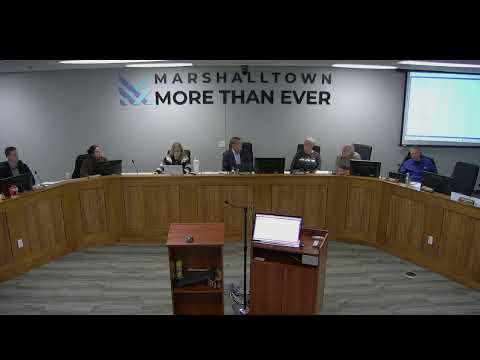
Marshalltown council narrowly directs staff to pursue funding for Flock Safety camera expansion
Summary
After a presentation from police officials on crime-solving gains, the Marshalltown City Council voted 4-3 to direct staff to prepare a resolution to fund an expanded Flock Safety camera program, with local option sales tax named as a backup funding source; privacy advocates urged stronger contract safeguards.
Marshalltown —'Dec. 8, 2025 '— The Marshalltown City Council voted 4-3 Tuesday to ask city staff to prepare a resolution and funding plan to expand the city's Flock Safety camera system, following a detailed presentation from police leadership about how the technology has aided investigations.
Captain Kyle Stevenson of the Marshalltown Police Department told the council the license-plate-reader program has been in full operation for about 15 months and has generated more than 270 documented uses and ‘‘160-plus arrests’’ tied to camera evidence. He said the system has been instrumental in a range of cases, including large-scale thefts, stolen-vehicle recoveries and several major investigations. "Nearly every big case you hear us report about, nearly every single one of those is coming down to Flock," Stevenson said.
Chief Chris Jones described a city proposal to add 26 additional license-plate-reader cameras, four pan-tilt-zoom cameras for downtown, and eight live-view traffic cameras. Jones said the current contract runs about $96,000 per year; the expansion proposal would add about $94,000, for a total near $190,000 before negotiations and possible fee waivers from the vendor.
Council members questioned how the expansion would be funded and what controls and audits exist. Jones and Stevenson said the city currently uses Automated Traffic (AT) funds for part of the program but that AT revenues would be insufficient to cover both a proposed expanded Flock deployment and a recently approved Axon contract for body and in-car cameras. Jones said city policy limits routine queries and staff audit access, and that misuse of the system can lead to serious personnel actions.
Several members of the public urged caution. Marco Yep Gomez, a resident, said the ACLU and the Electronic Frontier Foundation have raised concerns nationally about how third-party camera data can be used and urged the council to incorporate stronger contract safeguards before expanding access. "Flock has been a tremendous tool," Gomez said, "but we shouldn't dismiss the documented privacy concerns raised by advocacy groups."
Councilmember Thompson moved to direct staff to draft a resolution that would use local option sales tax as a backup funding source for the expansion and to return with a recommended annual amount and term; the motion passed 4-3 (Schneider, Thompson, Kell and Mitchell in favor; Fonka, Lyhoff and Nicholls opposed). Councilmembers who opposed the motion said they preferred reviewing the expansion within the broader upcoming budget process.
What happens next: Staff will prepare a formal resolution and funding plan for council consideration. Chief Jones said the vendor is willing to negotiate installation timing and fees, and staff suggested the city could potentially defer renewal timing to align with budget cycles.
The debate captured competing priorities: police officials emphasized case outcomes and public-safety benefits; some council members and residents emphasized fiscal review and added privacy protections. The council did not vote on procurement or contract language Tuesday; it directed staff to return with a funding resolution and additional details.