Get Full Government Meeting Transcripts, Videos, & Alerts Forever!
Get email alerts on the Charter City topic
No spam. Unsubscribe anytime.
El Segundo town-hall Q&A surfaces split over a narrow "charter-light" ballot proposal
Summary
City officials and residents debated a proposed "charter-light" city constitution that would largely preserve current rules but reserve limited municipal authority; the council will reconsider placing the measure on the November ballot at its July 7 meeting.
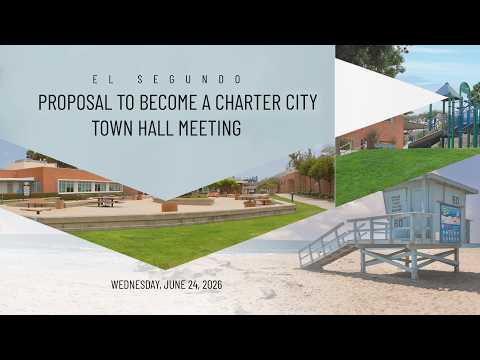
El Segundo officials and residents met in a town-hall style session to discuss a proposed "charter-light" city charter that, if approved by voters, would retain most current general-law rules while reserving limited municipal authority for future use.
The mayor opened the meeting by stressing the proposal is not meant to be revolutionary: "That's not our intent here. Our intent really isn't to change much at all," he said, noting the city moved elections to November to save about $280,000 a year and that holding a charter question during a general election greatly lowers incremental costs. The city attorney described the draft as a "charter light," emphasizing the document would leave most state-controlled areas such as CEQA and taxation unchanged while applying limited municipal authority to matters historically considered "municipal affairs." He also noted that any adoption or amendment would require voter approval and that the ballot threshold for passage would be 50 percent.
Councilmember McCarty said she remains skeptical of the measure and voiced concern about unintended consequences, citing a former councilmember's account in Huntington Beach where fiscal circumstances deteriorated after local-state confrontations. "I will continue to be a no vote on that," McCarty said, while acknowledging the public hearing process is the right place to resolve outstanding questions.
Residents pressed officials for specifics. Rick Reeser asked for a plain-language list of pros, cons and costs, saying he wanted to understand "what's good and what's bad about this in terms of the overall picture." Anya Goldstein, who said she had read the draft, criticized specific language in the charter (section 600) as confusing and warned poorly drafted text could create legal ambiguities that future councils might exploit. The city attorney and other council members responded that the draft intentionally hews to general law and that many perceived risks are hypothetical: "This is an insurance policy for the future," one official said, describing the charter as a way to reserve options should state law evolve.
Legal context was a recurring theme. Speakers noted that courts and state legislation have in recent years treated housing as a matter of statewide concern, limiting local control; whether that will change remains speculative. Officials also pointed to legal constraints on taxation and fees, citing voters' protections such as Proposition 13 and Proposition 218 as reasons property-tax authority would not shift under the charter.
Several residents urged the council to slow the process and expand outreach before placing the question on the ballot. John Pickhaber said the town hall felt like an "introductory meeting" and recommended more time for public engagement. Councilmembers and staff said the next formal step is a council decision on July 7; the city attorney noted an early-August county filing deadline if the council opts to place the measure on the November ballot.
The meeting produced no formal motion or vote; rather, it served as a public Q&A highlighting the central debate: whether a narrowly written charter that preserves most general-law constraints is a prudent "insurance" against future state actions or an unnecessary change that could create legal ambiguity and political risk. Officials repeatedly said the current draft aims to preserve existing governance practices while giving the city limited flexibility in the long term. The council will take up the item again at its July 7 meeting, at which point it may place the draft on the ballot, revise it, continue the discussion or decline to move forward.