Get Full Government Meeting Transcripts, Videos, & Alerts Forever!
Get email alerts on the Behavioral Health Care Coordination topic
No spam. Unsubscribe anytime.
Douglas County highlights ‘Familiar Faces’ coordination wins, flags gaps in medical respite and payer participation
Summary
Douglas County staff and local providers described progress using the MyRC data tool to coordinate weekly huddles around 20–25 high‑utilizer individuals, cited a marked reduction in one long‑running case’s emergency visits, and urged budget space to evaluate a real‑time platform and address shortages in medical respite and payer engagement.
Douglas County officials and partner providers used a June 24, 2026 work session to describe multi‑agency progress under the county’s "Familiar Faces" care‑coordination process and to outline persistent gaps that could limit future progress.
"If we can focus like a laser on that smaller group of people and make progress for them, all of this will be worth it," said Bob Triansky, director of behavioral health projects for Douglas County, explaining the county’s weekly huddle that reviews an algorithmically generated list of roughly 20–25 people at a time who repeatedly touch emergency services, jails and shelters. Triansky told commissioners the broader pool is about 120–140 individuals per year.
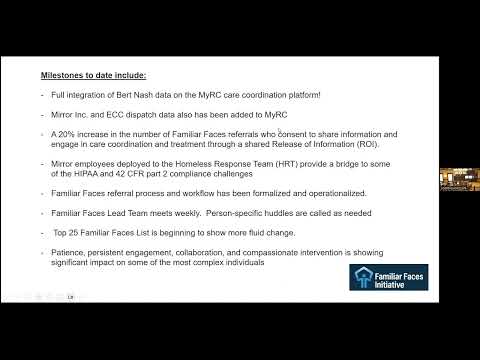
Triansky and partners said the county’s MyRC platform has expanded to include behavioral‑health partners, SUD providers and dispatch data. A partition for 42 CFR‑covered entities allows HIPAA‑sensitive sharing among approved partners, but presenters said MyRC is primarily retrospective and lacks tools to close referral loops and document real‑time care coordination.
"So far in 2026, this person has one ED visit. They have one ambulance run. They've been to the TRC five times. The last time was January 25th. They are now permanently housed and sober," Triansky said, citing a long‑running case the group calls a success of sustained, cross‑agency engagement.
Panelists credited frontline staff and a standardized shared release‑of‑information form for a 20% year‑over‑year increase in referrals where a release was obtained, improving the group’s ability to coordinate. But they flagged key limits: health plans (MCOs) do not sit in the weekly huddle because of data‑access and HIPAA complexities, shelter and TRC facilities lack dedicated medical respite capacity, and nursing‑home placements and guardianship processes can take months.
Lawrence Community Shelter leaders described growth from roughly 32 people per night to about 122 and said congregate shelter units are not suited for post‑surgical or medically complex recovery; they are piloting private "Monarch" units but said scaling requires compensation and liability protections.
Multiple presenters said the group has demoed a more capable care‑coordination platform (referred to as Gelata) that could integrate notes and tasks across electronic health records, but a conversion would likely take 12–18 months and require renegotiated agreements. Staff asked commissioners to consider budget supplementals to reserve capacity for a future platform purchase.
Commissioners pressed for specifics on funding and regulatory barriers. Panelists pointed to systemic issues outside local control — including limits tied to payer coverage and a lack of statewide policy levers — but recommended continuing to track utilization reductions and community savings to build a fiscal case for investments.
The work session closed with staff asking commissioners for guidance on follow‑up topics; the meeting recessed until a 5:30 business meeting.