Get Full Government Meeting Transcripts, Videos, & Alerts Forever!
Get email alerts on the Municipal Finance topic
No spam. Unsubscribe anytime.
Mulberry commission seeks detailed loan options as $5 million balloon payment nears
Summary
City staff told the Mulberry City Commission that a $5 million balloon note comes due in June 2026 and presented options including refinancing the $5 million, taking a larger $13 million loan to advance construction, or pursuing USDA/ grant opportunities; commissioners asked for amortization schedules and a fact‑finding workshop before deciding.
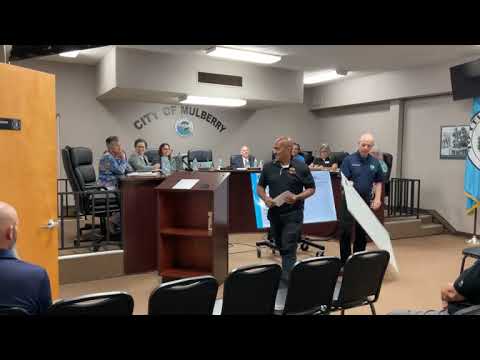
Mulberry — City staff told the Mulberry City Commission on April 21 that the city faces a $5 million balloon payment due in June 2026 and sought direction on whether to refinance that note or pursue a larger loan to fund continued construction on a development project.
“The fact is we have a $5 million balloon note that we need to take care of, which is due in June,” the city manager said, noting the maturity date is June 20, 2026, and that staff and consultants are exploring alternatives including refinancing the $5 million, obtaining a $13 million loan to cover broader work, and seeking USDA participation or grant opportunities to reduce borrowing needs.
Why it matters: Commissioners were told that a larger financing package could support more construction activity but also could reduce discretionary spending for several years. Staff said scenarios prepared with their consultant (Public Financial Management) show broad fiscal tradeoffs depending on interest rates, amortization schedules and assumed legislative changes to property tax policy.
Commissioners pressed for concrete numbers. “I don’t think we should carry more debt at this point,” Commissioner McDonald said, calling for a careful review of options. Other commissioners urged staff to provide an amortization table, payment schedules, interest‑cost estimates and a clear comparison of how each alternative would affect capital projects and routine discretionary spending.
Staff said negotiations are already underway with banking institutions and that a meeting with hired consultants was scheduled the following day to gather specific amortization and payment proposals to bring back to the commission. The city manager and legal counsel also mentioned potential federal and state funding tools — including brownfield incentives and grants — that could reduce the borrowing needed for cleanup and redevelopment of the property.
The commission did not adopt a financing plan at the meeting. Instead, members requested a one‑to‑two page fact sheet and an Excel‑style amortization schedule for each option (rollover of the $5 million, refinance terms, and the larger $13 million loan scenario), and directed staff to return with those specifics at the next meeting after the consultant workshop.
Next steps: Staff will meet with financial consultants, gather bank proposals and prepare detailed amortization scenarios for the commission’s review. The commission indicated it expects to take final direction at a subsequent regular meeting after reviewing those numbers.