Get Full Government Meeting Transcripts, Videos, & Alerts Forever!
Get email alerts on the Transportation topic
No spam. Unsubscribe anytime.
Douglasville hears 30-year transportation roadmap proposing 58 projects and $190 million in improvements
Summary
Consultant Mickey O'Brien presented a Comprehensive Transportation Plan proposing 58 projects over 30 years (2026–2055), with an estimated $190 million total cost and a near-term focus on Highway 5 and Chapel Hill Road; the council agreed to place the plan on the consent agenda for Monday.
Mickey O'Brien, the project manager for AECOM, presented the City of Douglasville’s draft Comprehensive Transportation Plan on May 28, outlining a 30-year roadmap that identifies 58 projects with a combined estimated cost of about $190 million.
"We've identified 58 projects," O'Brien said, summarizing the plan’s scope and its organization into three implementation tiers. He said tier-one projects are short-term, largely locally implementable improvements such as sidewalk gap closures and school-area safety measures; tier-two projects generally require larger funding and planning steps; and tier-three projects are long-range arterial or network investments.
O'Brien described four categories of projects: roadway safety and operations (11 projects, roughly $6.1 million), intersection improvements (seven projects, about $3.7 million), major roadway capacity projects (seven projects, about $125 million), and active-transportation projects including sidewalks and shared-use paths (33 projects). He told council the plan emphasizes safety, multimodal options, economic supports and resiliency.
The consultant framed the plan as necessary to compete for state and federal dollars administered through regional partners. "If you are located within a metro NPO, you must conduct a comprehensive transportation plan every five years to apply and receive federal funding," O'Brien said, noting the Atlanta Regional Commission’s (ARC) funding selection timeline and the need to pre-position priority projects for the region’s Transportation Improvement Program and TIP selection windows.
O'Brien identified Highway 5 and Chapel Hill Road as the plan's highest-priority needs, noting those projects will require partnerships with state and county agencies. He also told council that a recent pavement evaluation of city streets scored a 75 — above the national average of about 60–65 — and that bridge inspections are performed periodically by Georgia Department of Transportation staff.
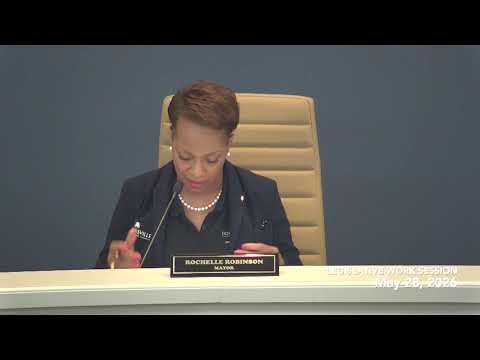
Council members asked technical and scheduling questions. Mayor Rochelle Robinson and Mayor Pro Tem Terry Miller thanked AECOM and city staff for the work and supported placing the item on the consent agenda for Monday’s voting meeting so the council can formally adopt the plan and begin pre‑positioning projects for funding.
The council did not take a final vote at the work session; adoption is scheduled for the Monday council meeting.