Get Full Government Meeting Transcripts, Videos, & Alerts Forever!
Get email alerts on the Local Preparedness topic
No spam. Unsubscribe anytime.
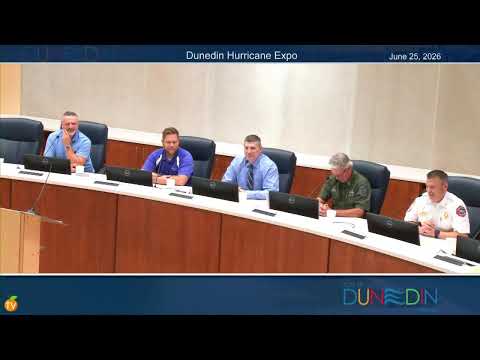
Dunedin officials at Hurricane Expo lay out pre-storm checks, pruning guidance and evacuation procedures
Summary
City and county officials at the Dunedin Hurricane Expo described how the city prepares drains and roads, recommended tree-care practices to reduce storm damage, explained flood-zone labels and described evacuation checkpoints and post-storm damage-assessment routines.
Local officials at Dunedin’s 2026 Hurricane Expo described the city’s operational preparations before a storm and what residents should expect during and after an event.
Trevor Bacon of Dunedin Public Works said staff follow the city disaster plan, inspect known trouble spots and outfalls, run vector trucks to check flows, and secure public job sites so fewer objects can become windborne hazards. "We check our outfalls to make sure they are open and free," he said, adding that crews stage equipment by neighborhood to clear roads and support first responders after a storm.
Rick Warner, the city arborist, advised homeowners to avoid heavy, last-minute thinning and lion-tailing. "Crown density is what you want," he said, explaining that excessive center-pruning concentrates weight at branch tips and increases failure risk. He encouraged year-round, species-aware maintenance and offered city guidance visits on request.
Joseph DePasqua, assistant director of community development and the city’s chief building official, explained flood-zone labels and the initial damage assessment process. "If your flood zone starts with an A or a V, you're in a high-risk special flood hazard area," he said; he also stressed that freshwater flooding can affect areas mapped as lower risk and that city preliminary damage assessments (PDAs) occur at daybreak after an all-clear and feed into a countywide database for recovery planning.
Fire Chief Michael Hendoga described operational thresholds for responder safety and the consequences of remaining during a mandatory evacuation: once sustained winds reach about 30 mph, crews may pull light vehicles; at roughly 45 mph they evaluate larger apparatus. "When you stay behind, you really do assume the risk," he said, noting responders may not be able to reach some calls during the storm and that preserving equipment is necessary to support post-storm rescue and recovery.
A Pinellas County deputy outlined barrier-island checkpoints and automated vehicle-mounted PA messages used during mandatory evacuations, and warned residents that loss of power can prevent calls for help after landfall. Officials advised delaying the immediate return after a storm to avoid long traffic backups that impede emergency operations and said the city performs a systematic first push to clear routes for emergency services before reopening neighborhoods.
Officials also described infrastructure projects such as Kuru and Cedar Creek clearing, which removed an estimated 25,000 cubic yards of vegetative debris to improve conveyance and reduce local flooding risk; they cautioned, however, that surge-driven flooding paths remain hard to predict.
The panel closed by urging residents to plan evacuation destinations in advance, document belongings for insurance, and use public shelters as lifesaving options when needed.