Get Full Government Meeting Transcripts, Videos, & Alerts Forever!
Get email alerts on the Invasive Plants topic
No spam. Unsubscribe anytime.
Richmond commission moves to seek bids for invasive-plant work while debating herbicide use
Summary
The commission agreed to prepare a boilerplate RFP to solicit contractors for invasive-plant work at two town parcels and to run that procurement in parallel with a multi-meeting education process to develop guiding principles on herbicide use.
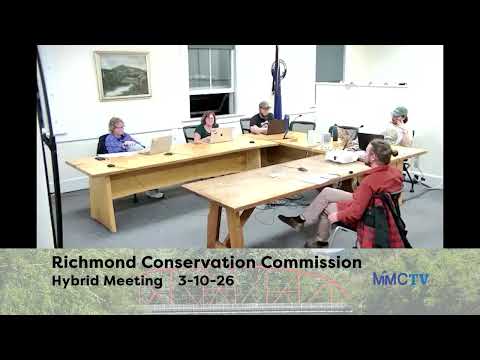
The Richmond Conservation Commission on March 10 agreed to advance a draft request for proposals (RFP) to solicit contractors to assess and treat invasive-plant infestations at town sites while continuing an internal education process about herbicide use and management priorities.
Commissioners said the RFP should cover at least two target areas the group has discussed (the Volunteers Green floodplain forest area described in the commission's management plan and a second parcel the transcript refers to as "Overrocker"/"Overacher"). The commission asked staff and volunteers to treat the RFP as a pilot procurement: solicit proposals for treatment approaches, expected timelines and budgets, and ask bidders to identify which species they would treat and the methods they would use (manual methods, stump‑cut treatments, targeted herbicide applications, monitoring schedules). The commission agreed it can then evaluate proposals against a set of guiding principles to be developed.
Janette, who has reviewed the existing management plan, said the plan is thorough and can be updated; she and others recommended not delaying treatment simply to finish a full inventory, and several members urged starting with a pilot that uses mapping during treatment to build a project record. John recommended asking contractors for GPS‑based mapping and for experience working in floodplain forest conditions. Commissioners discussed running the pilot for multiple years (three suggested, some spoke of three to five years as a realistic timeframe) and noted CRF rules and available funds will affect budgeting for multi‑year work.
A substantial portion of the discussion addressed herbicide use. Commissioners said they lacked consensus and information about when and where targeted herbicide applications are necessary, particularly for species like knotweed (Japanese knotweed) and phragmites; the commission agreed to pursue an education path that includes:
- assembling background resources (organic/organic-land-care guides and invasive-plant case studies), - inviting informed practitioners or contractors to brief the commission (with questions provided in advance), and - holding focused meeting time to establish the commission's guiding principles on allowable treatments and on public communication.
Members emphasized that some species are very difficult to control by mechanical methods alone and that professional help may be required. The commission noted that professional contractors may recommend different approaches for different species and sites; the RFP will ask for explicit methods and safety protocols so the commission can judge proposals against its emerging principles. Commissioners asked volunteers and staff to finish a near-final RFP draft for review at the next meeting so it can be posted in a timely manner.
The chair said the commission will pursue the RFP and the education track concurrently: the RFP will solicit proposals and costs while the commission completes its review of stewardship guidance and community-facing messaging about herbicide use.