Get Full Government Meeting Transcripts, Videos, & Alerts Forever!
Get email alerts on the Communications Tower topic
No spam. Unsubscribe anytime.
Residents press for broader, clearer tower rules; planning commission sends proposed revisions to council
Summary
Residents appealed a previous cell-tower variance and presented a set of proposed amendments to Nisswa's Chapter 20 communications-tower rules, urging allowance on private property, fall-zone setbacks, monopole preference, a clearer appeals process and other technical additions; the planning commission voted to forward the suggested revisions and staff review to city council.
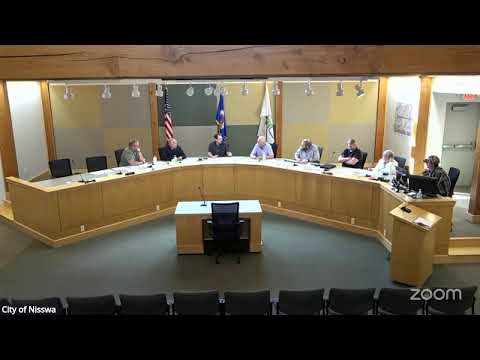
Residents involved in a recent cell-tower variance appeal urged the Nisswa Planning Commission on June 2 to revise the city's communications-tower ordinance to improve clarity and broaden siting options.
Paula West, who identified herself as living at 25839 Trailside Run and as an appellant in the earlier variance, said she and a colleague prepared a set of recommendations and asked the commission to consider them as an amendment to Chapter 20. "We felt that it was important to look at our current tower ordinance and see if there's ways that we can improve it to make a win-win situation for the community and for the residents," West said.
A second presenter (identified in the transcript as Roger Landers and later as Ron Gerlanders) summarized the proposals: expand allowable locations beyond the current public recreation designation to some private and highway-business zones, incorporate a fall-zone setback equal to tower height plus 10 feet, and prefer monopole designs rather than lattice towers. He cited Crowing County model language included in their packet and said opening some nonpublic zones could locate towers away from residences while improving downtown coverage.
The presenters also proposed seven specific additions adapted from the Crowing County ordinance: clarify applicability, require owner contact information on accessory-building signage, specify accessory-building lighting standards, require scaled site plans, request current FCC documentation for submitted safety standards, require proof of good-faith efforts to co-locate on existing towers before building a new one, and enumerate factors for CUP approval (visual obtrusiveness, co-location, etc.).
Planner Stephen responded that several points could be handled administratively (for example, a clarified appeal form or a staff-prepared process diagram) while other changes would require codified ordinance language and public hearings. He noted the city already adopts by reference Section 704 of the Telecommunications Act of 1996 and therefore does not make land-use decisions based on FCC-established health thresholds.
Commissioners discussed whether to allow towers on private property, how to harmonize setbacks if towers were allowed in residentially zoned districts, and the potential to limit tower design to monopoles for visual and safety reasons. Commissioners agreed it would be prudent to bring the proposals to city council for direction. A motion to add the matter to the council agenda and direct staff to start drafting proposed ordinance language carried.
Next steps: planner Stephen said he would prepare a comparative memo and redline language cross-referencing Crowing County and neighboring municipal standards, then bring the item to city council and back to the commission for public hearings as required.