Get Full Government Meeting Transcripts, Videos, & Alerts Forever!
Get email alerts on the Enrollment And Facilities topic
No spam. Unsubscribe anytime.
Monona Grove officials outline declining births, housing mix and implications for school facilities and budgets
Summary
Superintendent Tanya Frederick and board member Philip Haven presented data showing flat resident enrollment at Winna, declining local births, and how apartment‑focused development along Broadway is likely to produce far fewer elementary students per unit—factors driving facility planning and budget choices.
Superintendent Tanya Frederick said Monona Grove School District leaders are using enrollment, birth and housing data to guide long‑range facility decisions, emphasizing that “every facilities conversation ultimately comes back to supporting students, staff, families, and the long‑term sustainability of the district.”
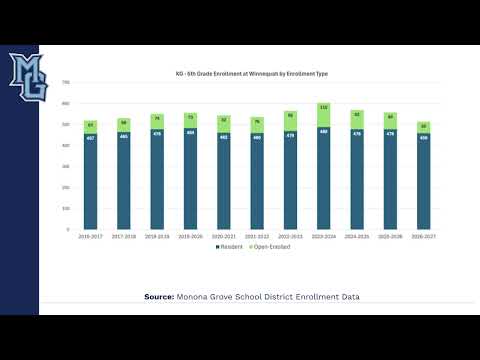
Frederick told the board the district analyzed resident kindergarten–fifth grade enrollment at Winna to focus on the students the district is statutorily obligated to serve and to avoid noisy 4K volatility. That resident K–5 cohort has been essentially flat over the past decade, she said, with the district projecting about 459 resident students at Winna in the 2026–27 planning year compared with roughly 457 in 2016–17.
The presentation separated resident students from open‑enrolled pupils to clarify planning and financial impacts. “Open enrollment trends at Winna have largely determined the cap the size of the student population there over the years,” Frederick said; the district now plans for about 55 open‑enrolled students at Winna for 2026–27. Officials noted the district receives less funding per open‑enrolled student, which can complicate classroom and support‑staff funding.
Board member Philip Haven described the enrollment planning tradeoffs: “It’s such a tightrope walk when we talk about what’s the ideal number of kids to have in a school … you don’t want it to be too low and you don’t want it to be too high,” he said, stressing that both educational vibrancy and operational efficiency matter.
Presenters also used housing analysis to explain why population increases do not necessarily translate into more schoolchildren. The district reported most Winna students come from single‑family homes; existing apartment developments near the Yahara River (three combined buildings totaling 362 units) produced very few Winna students in recent years — only about three students from those 362 units for the coming year — and district staff said a 600–700‑unit Broadway corridor project could similarly yield only a small number of elementary students (perhaps a low‑double‑digit increase, not hundreds).
Frederick and staff pulled birth data from the Wisconsin Department of Health Services to show a long downward trend in births to Monona residents, noting births fell into the mid‑30s in recent years. The district said the 2015–2020 birth cohort largely explains current Winna enrollment and that births from 2020–25 will shape 2030–31 cohorts.
Officials emphasized the limits of some projections — census, birth and MLS housing data offer context but are not “crystal balls” — and said the district will continue local family surveys and data collection to track where families are choosing non‑district options, including parochial and virtual schools. Frederick said those surveys will resume this fall to inform recruitment and budgeting plans.
The presentation closed with a reminder that enrollment directly drives revenue and budget choices, and that the district will monitor enrollment daily ahead of the official September 1 count.
The board did not take new formal votes during this presentation; the meeting served to inform the public and to guide further planning.