Get Full Government Meeting Transcripts, Videos, & Alerts Forever!
Get email alerts on the Referendum topic
No spam. Unsubscribe anytime.
Carmel Clay Schools board votes to put combined operating referendum on November ballot
Summary
After public comments and extended debate about enrollment and budget assumptions, the board voted unanimously to place a single eight-year operating referendum on the Nov. 3, 2026 ballot that would repeal and replace the district's existing referendums; the resolution sets a proposed maximum levy and rate that drew calls for further fiscal review.
The Carmel Clay Schools Board of Trustees voted to adopt a renewal of a referendum tax-levy resolution that will place a combined operating referendum on the Nov. 3, 2026 ballot, after public comment and more than an hour of board discussion about enrollment forecasts, tax caps and fiscal oversight.
The resolution authorizes placing an operating referendum question before voters that would repeal and replace the district’s existing operating and safety referendums and allows a maximum levy amount the board presented at the meeting of $61,981,519 and a proposed maximum property tax rate cited in the resolution of 0.4274 (about 42.74 cents). Board members emphasized that the vote authorized putting the question to voters, not an adoption of the levy itself.
“Tonight we are voting to put a referendum on a ballot and what levy amount that would be. That does not mean we are voting yes or no on it. We are giving our voters a choice,” said Mrs. Cashion, a board member.
Administration and the board said the measure responds to recent legislative and revenue changes that, the district says, create a structural financial challenge. Superintendent Dr. Orike summarized four public meetings and analyses prepared in partnership with a policy-analytics firm that informed the draft ballot language and fiscal model. Legal counsel Eric Long of Ice Miller told the board the practical deadline to finalize legal work and submit ballot language for a Nov. 3 election is noon Aug. 1 (practically July 31), after which county and state processes must be completed.
Several board members urged caution about locking in an unnecessarily high ceiling, while others warned that a lower ballot figure could hamstring future boards and jeopardize services. Miss Wheeler and others argued that cutting the amount on the ballot could mean reductions in staff and services to students; Mr. Brown pushed for more detailed budget scrutiny and moved to amend the ballot figures downward, but his amendment failed for lack of a second.
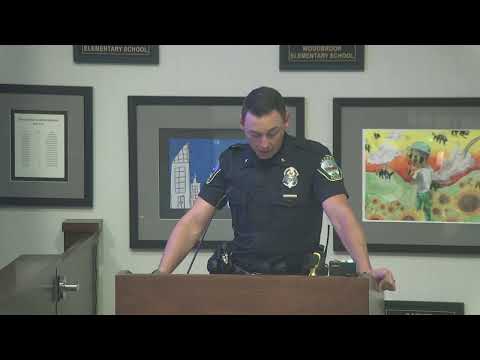
Public commenters framed the vote in community terms: Drake Sterling, chief of the Carmel Police Department, urged support and described the school resource officer program — which he said is funded largely through the referendum — as a preventive, award-winning program that builds trust between students and officers. Park McMillan, a Carmel High School teacher and debate coach, told the board that well-funded schools raise property values and support economic development and urged citizens to vote in favor of placing the question on the ballot.
District finance staff warned that the mechanics of state certification affect timing and collections: Mrs. Kushar said the Indiana Department of Local Government Finance will certify or lower rates but will not increase them after certification, meaning the board must request levy authority by the DLGF deadline if it wishes to collect referendum revenue in 2027. She also reviewed timing for net assessed value certification (Aug. 1), enrollment-count timing (official counts in mid-September) and near-term expense pressures (retirement contributions, insurance and other fixed costs).
The board voted by voice and the resolution passed 5–0. Following the vote, administration said it will proceed with finalizing the ballot language, coordinate with the county election board, and continue to provide the board with detailed budget analyses and community communications.
What happens next: If the board-certified ballot language is filed by the July deadline and the DLGF approves, the question will appear on the Nov. 3, 2026 ballot for Carmel Clay Schools voters to decide. If voters approve the referendum, the district would be authorized to levy within the approved ceiling; if it does not pass, the DLGF would adjust certified rates and the district would plan 2027 budgets accordingly.