Get Full Government Meeting Transcripts, Videos, & Alerts Forever!
Get email alerts on the Field Fund topic
No spam. Unsubscribe anytime.
Arlington sports commission hears field-fund update; account holds about $700,000 as fee changes take effect
Summary
The sports commission received an update on the field fund’s history, current balance (~$700,000), recommended uses (two maintenance positions and turf conversions), and FY27 fee changes; commissioners discussed limits on accumulation, possible alternative uses and how leagues are notified of fee changes.
The Arlington Sports Commission received an update on the county's athletic field fund and related fee changes during its meeting. A DPR presenter, identifying themselves as the sports unit manager, told commissioners the fund was established around FY2011 to support athletic-field maintenance, capital projects and (initially) youth-sports scholarships and that the account now holds approximately $700,000, with another $280,000–$290,000 expected to be added for FY27.
The presenter summarized how the fund began as an $8-per-player flat fee and was later reorganized (FY2014) into separate rectangle and diamond accounts and an adult team fee. Recommendations from a FY2021 field-fund working group — five meetings leading into the FY2023 budget process — included a revised fee structure (separate amounts for 8-and-under versus 9-and-up), reconsolidation of funds into a single account, funding for two full-time athletic-field maintenance positions, prioritizing synthetic-turf conversion projects guided by the Public Spaces Master Plan, and annual briefings to the sports commission.
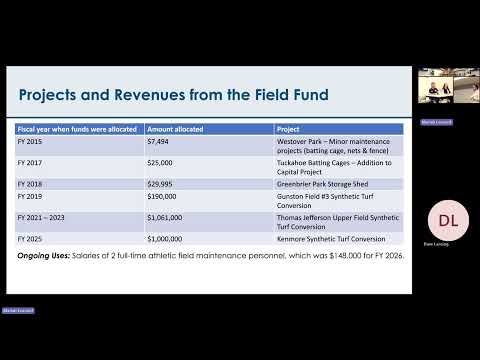
"We have approximately $700,000 in the account currently," the presenter said, noting the account's ongoing uses include roughly $150,000 this fiscal year for the two maintenance positions. The presenter emphasized that when the fund contributes to larger conversion projects (for example, Kenmore, Gunston and Thomas Jefferson), it typically supplies a portion of project funding rather than covering full construction costs.
Commissioners asked whether the fund has a statutory cap or must be spent after it reaches a threshold; staff replied there is no accumulation limit in place and that the commission can advocate to the county board about alternative uses if members wish. Commissioners also discussed whether the commission should press to restore scholarship money directly from the field fund; staff said leagues currently handle most need-based scholarship distributions and that the working-group recommendation prioritized staffing and conversions but that advocacy for other options could be raised.
The presentation included outcomes of past field-fund spending: West Park (minor improvements and batting cages), Greenbryer (storage shed), the Gunston diamond turf conversion and a Thomas Jefferson turf project. Commissioners pressed for clarity on how the team fee works: staff confirmed the adult team fee is assessed per team (currently shown at $200 per team for FY27) rather than per player, and that resident versus nonresident fees are displayed separately on the fee schedule.
On timing and outreach, staff said FY27 fee changes take effect July 1 (the start of the county fiscal year) and that leagues have been notified as part of the DPR and county manager budget process and the DPR resolution. Staff recommended using the Public Spaces Master Plan to prioritize which fields are converted to synthetic turf, focusing on multiuse sites that serve many leagues and programs.
Commissioners did not take a formal roll-call vote on any ordinance or budget item during the meeting. Next procedural steps noted by staff include continued annual briefings to the sports commission and incorporation of commission comments into materials sent to the county board for items such as the proposed fee updates.
The commission also discussed scheduling and other agenda items before adjourning; staff will circulate a revised annual report/work plan for final comments before sending it on to the county board.