Get Full Government Meeting Transcripts, Videos, & Alerts Forever!
Get email alerts on the Aviation And Height topic
No spam. Unsubscribe anytime.
Arlington advisers press FAA, MWAA and applicant on aviation trade‑offs as Langston Boulevard plan eyes taller towers
Summary
At a June 23 LRPC meeting, planners, airport authorities and the project applicant debated proposed tower heights for 1401 Langston Boulevard after the applicant submitted an FAA "no hazard" determination; MWAA and some commissioners urged modeling of one‑engine‑inoperative (OEI) impacts to evaluate operational and economic trade‑offs.
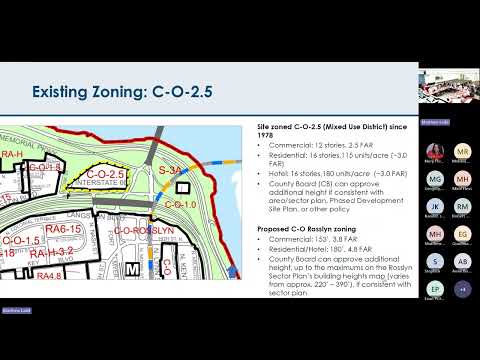
Members of Arlington County’s Long Range Planning Committee on June 23 debated whether the county’s fall 3D modeling for the 1401 Langston Boulevard Special GLUP study should account for airline operational constraints tied to one‑engine‑inoperative (OEI) flight corridors, after the applicant reported an FAA “determination of no hazard” for the tallest proposed tower.
The applicant, Chris Gladstone, representing Quadrangle Development Corporation, told the panel the development needs sufficient floor‑area ratio to be economically viable and said the team had submitted an FAA determination on June 8 for its tallest building. "On June 8th, the FAA issued its determination of no hazard to air navigation for our proposed 400‑ft height above sea level," Gladstone said, adding the scheme places slender towers to preserve views and light.
Jennifer Candel, an airport planner with the Metropolitan Washington Airports Authority, urged the committee to consider airline and airport concerns about OEI corridors. "There’s very limited options here," Candel said, explaining that if OEI surfaces are encroached airlines could face weight penalties or be forced to change routings. She added that FAA jurisdiction is limited to hazard determinations and that airports and airlines raise OEI concerns for long‑term operational planning.
Several commission members asked for quantitative evidence of which flights or procedures could be affected. "I don’t have that information… without asking each airline to sort of give us their own analysis," Candel said. Commissioners noted that FAA’s hazard finding and MWAA’s operational concerns are distinct: FAA evaluates safety/hazard while MWAA and carriers emphasize operational throughput and long‑term corridor protection.
A common procedural question was whether modeling should include OEI constraints. Many LRPC members and advisory‑group representatives recommended including OEI as an option in the upcoming 3D scenarios so the county can test potential trade‑offs; others cautioned that OEI is primarily an airline/airport operational and economic consideration and that mandatory modeling could constrain housing and community benefits. "It should be included in the modeling, presuming that it can also be an option," said Dave Earley of the Parks and Recreation Commission. Jason Schwartz of the Housing Commission opposed mandatory OEI modeling, arguing it could reduce housing feasibility.
Staff emphasized that FAA letters are part of the permitting pathway—the county requires a FAA determination of no hazard before issuing building permits—but noted that MWAA and airlines have historically petitioned FAA determinations when they considered OEI implications significant. The panel concluded it wants modeling that can test OEI impacts alongside scenarios that do not incorporate OEI, so LRPC can evaluate trade‑offs before advising further study.
Next procedural steps: staff will use tonight’s input to shape fall modeling options that include — as requested by several members — scenarios both with and without OEI constraints and will present those to LRPC for further guidance.
Ending: The committee did not take a vote on heights or modeling tonight; staff said fall scenarios and additional analyses will frame future LRPC recommendations.