Get Full Government Meeting Transcripts, Videos, & Alerts Forever!
Get email alerts on the Opioid Settlement Funds topic
No spam. Unsubscribe anytime.
Hancock County advisory committee hears MOSS Center on opioid settlement funds; members plan grant process
Summary
At its inaugural meeting the Hancock County Opioid Settlement Advisory Committee heard a MOSS Center briefing on how settlement funds are distributed, reviewed local balances and spending, elected leadership and agreed to draft application templates, scoring criteria and a community profile ahead of the next meeting.
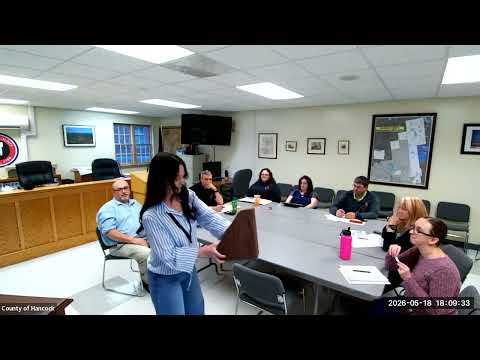
At their inaugural meeting, the Hancock County Opioid Settlement Advisory Committee heard a presentation from the MOSS Center outlining how Maine's opioid settlement funds are distributed and began organizing a grant application and review process the committee will recommend to county commissioners.
"Fifty percent of the funds are through the Maine recovery fund," said McKenzie David, research and evaluation coordinator for the MOSS Center, "the other 30% are direct-share subdivisions and the other 20% are with the attorney general's office." McKenzie said the center provides no-cost technical assistance to subdivisions, including application templates, scoring rubrics and a public dashboard showing reported spending.
Why it matters: Hancock County is a direct-share subdivision and will use the advisory committee's recommendations to guide how roughly $2.6 million in estimated settlement payments are prioritized locally over the coming years. The committee's work will influence which local recovery, treatment, harm-reduction and prevention projects receive county-backed grant awards.
Committee business and organization: County administrator Michael Kirker opened the meeting, described the committee's advisory role to the commissioners and led introductions. Members moved and seconded a volunteer to serve as chair; Renee Moiselak moved the nomination and Audrey Stewart Gordon seconded. A separate motion to appoint a vice chair was also made and approved by voice vote. Staff explained the committee will use staggered initial terms (one, two and three years) determined by a random draw.
Bylaws, meeting rules and remote participation: Kirker asked whether members wanted additional rules of order beyond the drafted bylaws and explained the county's remote participation policy: in-person attendance is preferred but Zoom is allowed under county parameters, and remote members must state their votes on the record.
Local finances and early spending: MOSS Center staff shared Hancock County figures from LD110 reporting: estimated total settlement payments of about $2,555,000; funds received to date roughly $926,000; cumulative funds spent through reporting to date about $202,000 (with roughly $130,000 spent in 2025); and an unspent balance reported at about $764,000. McKenzie noted these figures are taken from attorney general office reporting and the MOSS Center's public dashboard and described them as estimates.
Jail services funded by settlement money: Jail administrator Tim Richardson described increased medical and behavioral-health spending covered by settlement money this year: a contracted vendor providing 40 hours per week of in-facility mental-health coverage, expanded nursing hours and scheduled psychiatrist medication management. Richardson said the funds "bridged the gap" for the jail's MAT and mental-health services and emphasized the need for transparency in how the money is tracked and reported.
Examples, allowable uses and technical assistance: MOSS Center staff pointed the committee to Exhibit E (the settlement's list of allowable uses), shared examples of different county approaches (some counties concentrated funding in recovery centers, others in jail services or a mix) and offered templates for applications, scoring rubrics, tiers of awards and project-tracking tools. Jenna Gooto, MOSS Center outreach coordinator, said the center is funded through the attorney general's office and is "of no cost to you," stressing the center's role as a technical-support resource rather than a fund recipient.
Next steps and schedule: The committee asked the MOSS Center and staff to circulate an updated community profile, draft application template and scoring rubric before the next meeting. Members discussed whether to use community engagement (surveys, workshops) or committee expertise to set priorities; staff recommended the community profile and some local data be used to inform scoring criteria. The committee set its next regular meeting for Thursday the 18th at 5 p.m. (same location) and adjourned by motion and second.
What the committee noted but did not decide: Members emphasized that the committee's outputs are advisory and that the county commissioners will make final funding decisions. Committee members debated balancing jail needs and broader community investments and discussed possible award sizes and sustainability criteria; no final funding priorities or award amounts were adopted at the meeting.