Get Full Government Meeting Transcripts, Videos, & Alerts Forever!
Get email alerts on the Campus Master Plan topic
No spam. Unsubscribe anytime.
West Goshen continues hearing on West Chester University master plan as housing and pedestrian links draw scrutiny
Summary
At a June 23 hearing the West Goshen Township Board of Supervisors heard testimony on West Chester University's campus master plan, focusing on a short-term push for student housing, recommended bed counts, and where sidewalks, crosswalks and intersection work should be tied to new construction. The board continued the hearing to June 30.
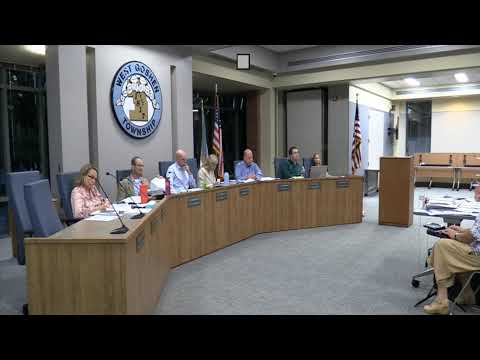
The West Goshen Township Board of Supervisors on Tuesday continued a conditional-use public hearing on West Chester University's campus master plan after multiple nights of testimony focused on student housing numbers, sidewalk and intersection improvements, and how the university's proposed projects would be linked to traffic-calming and stormwater work.
The meeting, opened by the board at 6:00 p.m., began with the solicitor, Kristin Campman, marking the board exhibits and outlining the hearing process under the Municipalities Planning Code and the township's Planned University Main Campus Overlay (chapters 84-135 and 84-137 cited). Counsel for the university, Brian Nagel, told the board the Borough of West Chester concluded its hearings earlier and expects to issue a decision on the borough portion of the master plan on Aug. 19; the town's hearing remains an independent review.
"Just because a project is shown on the master plan, it doesn't mean that the university will actually proceed with that project," university counsel Brian Nagel told the board, underscoring that projects must be funded and approved separately. The plan and its appendices (enrollment, housing, traffic/parking, stormwater and a master site plan) were entered into the record.
Master planner Conrad Talley (UEA Cole) described the plan's scope and priorities, saying the university and consultants evaluated more than 100 candidate projects and prioritized those expected in the near term. "Student housing was absolutely put forward as a priority by the institution," Talley said, noting prioritized work includes short-term renovations, additions and a set of projects identified in 0'5 years and others in 6'10 and 10+ year bands.
What the plan shows and what may be built differ, Talley and counsel emphasized. The updated materials presented to the board omit a previously suggested parking garage adjacent to the Sykes Student Union; those materials show retention of surface parking and an expansion of the union instead. Talley also described proposed corridor and stormwater improvements along Rosedale Avenue and signaled that major roadway changes would require coordination with PennDOT and with West Chester Borough when the work crosses borough streets.
Student housing and the demand question dominated much of the evening. MGT Consulting's Rob Kellner testified that his firm's student-housing demand model produced a three-year demand estimate of roughly 2,386 students but that a pragmatic university-side recommendation is to plan for 750 to 1,100 new beds in the near term. The master plan materials presented by the applicant show roughly 900 beds in the plan horizon.
"We would recommend 750 to 1,100 beds," Kellner said when asked to state MGT's short-term recommendation. Board members pressed how a recommended range of up to 1,100 beds squares with the plan's shown capacity and asked whether the university might ultimately propose more beds or different sites; the applicant said individual land-development proposals would return to the township or borough for detailed review.
West Chester University's interim enrollment official, Dr. Sarah Freed, gave updated enrollment counts and projections to the board and said housing availability affects both student choice and retention. She reported total university enrollment of about 17,400 students for fall 2025, spring 2026 enrollment of about 16,483, and a main-campus headcount of roughly 14,672. Dr. Freed and university materials project on-campus enrollment of about 14,592 through 2029 under the figures in the university's appendix.
Several supervisors and attendees urged tighter linking of major projects to safety and connectivity work on public streets. Supervisors repeatedly asked for clearer, project-by-project commitments tying sidewalk construction, crosswalk/intersection improvements and traffic-calming measures to the housing projects shown in the plan (the board flagged the Sites area, Rosedale Avenue and New Street as specific priorities). The applicant replied that detailed sidewalk and pedestrian designs typically are developed at the land-development stage, but that the implementation schedule (appendix A7) will be further refined and that some corridor work will require outside approvals.
Chester Valley Engineers' Neil Caymans described the master site plan mapping (appendix G) and the conceptual stormwater-management strategy, noting the applicant mapped proposed projects onto the campus and grouped them by timing bands; he confirmed that the more detailed engineering for stormwater and pedestrian improvements will be part of future land-development reviews.
No formal vote was taken. The board continued the hearing to Tuesday, June 30 at 6:00 p.m.; the board said it will not mail additional notices but will allow interested neighbors who could not attend to request party status at the continued hearing.
What's next: the hearing resumes June 30, when the university team is expected to finish witness testimony on stormwater and other technical topics. Any land-development application that would implement specific projects shown in the master plan will require separate, project-level approvals from the appropriate municipality (West Goshen Township or West Chester Borough) and coordinating agencies such as PennDOT.
Sources and attribution: Quotes and technical claims in this article are drawn from testimony and exhibits read into the public record at the West Goshen Township Board of Supervisors hearing on June 23, 2026. Direct quotes are attributed to the witnesses who spoke in the hearing record (Conrad Talley, Brian Nagel, Rob Kellner, Dr. Sarah Freed, and Neil Caymans).