Get Full Government Meeting Transcripts, Videos, & Alerts Forever!
Get email alerts on the Local History topic
No spam. Unsubscribe anytime.
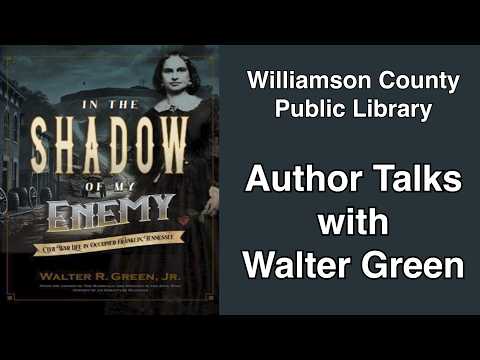
Author Walter Green details Franklin occupation, hospitals and new local counts in public talk
Summary
At a public talk on the Battleground Academy campus, author Walter Green described research from his new Civil War book about Franklin, Tenn., including a population analysis, lists of surviving Civil War–era houses, disputed counts of temporary hospitals and aggregate casualty figures from the Battle of Franklin.
Paige Hurley introduced Walter Green onstage at the Battleground Academy campus library, thanking the audience and noting her years helping him format and research his new Civil War book. "It's been a joy to work with him," Hurley said, before handing the mic to Green.
Author Walter Green told the audience he wrote the new book to collect resident-centered stories of Franklin during the Civil War rather than focus only on battlefield images. "I'm grateful for the book because it sat there," Green said, noting he drew on local archives, Williamson County Historical Society journals and special-collections materials to assemble maps, household lists and firsthand quotes.
Green said his research established a baseline picture of Franklin before the war and a set of local findings that he said will aid historic tours and preservation work. He told listeners he estimated roughly 150 households in the period, that the town was "about 70% white," that roughly half the households included enslaved people, and that about 34 of the Civil War–era houses he identified still stand. He described a population and household analysis placed in an appendix of the book.
A central focus of Green’s talk was occupation: he traced the arrival and responsibilities of provost marshals, loyalty oaths and travel passes, and described how signing an oath could restore trading and travel privileges. Green said occupation began in earnest in early May 1862, that the town changed hands at least 13 times during the war, and that for periods Franklin hosted large federal troop concentrations—up to about 8,000 troops in early 1863—when Fort Granger was constructed on Figures Bluff.
Green also addressed wartime health care and burials. He reported compiling lists of temporary hospitals and said he identified 35 by name in his research, while noting that other historic lists conflict and that some counts in circulation may be inflated; he offered a working upper-bound suggestion in the talk of as many as 70 temporary hospitals while emphasizing the uncertainty. On casualties, Green cited aggregate figures for the Battle of Franklin—about 6,200 Confederate and 2,300 Federal casualties (including killed and wounded)—and estimated roughly 1,600 Confederate dead and a couple hundred Federal dead were left behind in town after the battle.
Throughout his presentation Green interwove family and individual vignettes—such as the story of Andrew Ewing, who later enlisted with U.S. Colored Troops, and accounts of women who managed households and property during occupation—to illustrate civilian experience alongside military events. He described the town’s post-battle burial effort, in which local citizens raised money and contracted workers to exhume and identify remains for reinterment in what became the McGavock Confederate Cemetery.
During a question-and-answer period, audience members asked about commanders at the second battle of Franklin, where families expelled from town went, and how Tennessee fit under the Emancipation Proclamation; Green answered from his research and acknowledged gaps where contemporary records are incomplete. He said he had documented many names, regiments and provost marshals but that certain specifics—such as an exact surrender date for Franklin early in the war—remain unknown in the surviving sources.
Green framed the book as non-fiction, footnoted and founded on archival materials rather than on speculation. He said the research produced materials he hopes will help tour guides and local preservationists, and that some questions in the book may prompt further local archival work. The event closed after audience questions and Green declined for now to commit to a follow-up volume focused on Reconstruction, saying he is considering whether to pursue it.
The book described at the lecture includes maps of surviving homes and farms, a chronology of army control, lists of regiments and provost marshals, a population appendix and a chapter of personal vignettes drawn from local letters and journals. Green encouraged attendees to contact him or the library with corrections or missing dates that might refine the record.