Get Full Government Meeting Transcripts, Videos, & Alerts Forever!
Get email alerts on the Data Centers topic
No spam. Unsubscribe anytime.
Hillsborough extends data‑center moratorium for one year to allow regulatory review
Summary
The Hillsborough Board of Commissioners voted to extend a temporary moratorium on data‑center development from 60 days to one year so staff can research best practices and draft Unified Development Ordinance (UDO) changes addressing noise, water use, decommissioning and public‑safety concerns.
The Hillsborough Board of Commissioners voted to extend a development moratorium on data centers from 60 days to one year, giving staff time to research best practices and prepare changes to the town’s Unified Development Ordinance.
The moratorium, adopted under North Carolina General Statute 160D‑107, was proposed to allow the town to study how 24/7 data‑center operations might affect utilities, noise, water quality and emergency response. "Data centers are a unique industrial use. They are different from other industrial uses in that they operate 24/7," said Megan Kimble, a senior attorney at the Southern Environmental Law Center and Hillsborough resident, during the public hearing. She added that many communities are pausing to adopt location‑specific standards and urged either conditional rezoning or special‑use review rather than as‑of‑right approval.
Speakers during the public comment period raised environmental and cultural concerns. "Data centers require millions of gallons of water per day to cool themselves. Even the small‑scale data centers require 3 to 500,000 gallons of water per day," said Tremaine Jefferies, who spoke on behalf of members of the Occaneechi Band of Saponi Nation, warning of potential runoff and impacts to the Eno River watershed. Residents also cited constant low‑frequency noise and the loss of small‑town character as key risks; Maggie Saunders described the prospect of building a data center without tribal consent as "equivalent to rape." These comments featured prominently in commissioners’ deliberations.
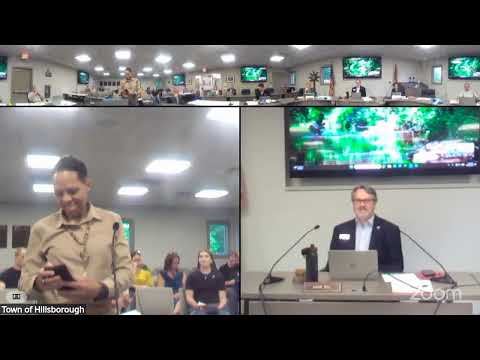
Town staff and commissioners reiterated that no formal application for a data center had been submitted. "We do not currently have any proposals that have been submitted for a data center," staff said during the hearing, adding that the moratorium is preventive so regulations exist before an applicant arrives. Commissioners cited additional technical issues — potential contamination and recycling of cooling water in warmer climates, ambiguities around decommissioning, constraints on local power infrastructure, and tax and job impacts — as reasons to take more time to craft local rules.
Commissioner discussion emphasized seeking robust standards tailored to Hillsborough. Commissioners asked staff to review regional examples and legal constraints, including state limits on downzoning, and to return with UDO amendments and recommendations. A motion to place a one‑year moratorium passed by voice vote.
Next steps: staff will gather best practices, consult regional partners, and draft UDO language and permitting pathways for the board’s future consideration. The moratorium will remain in effect for one year to allow that work to proceed.