Get Full Government Meeting Transcripts, Videos, & Alerts Forever!
Get email alerts on the Deferred Payables topic
No spam. Unsubscribe anytime.
Finance director: $110M in deferred bills, $90M structural gap as Jersey City seeks $120M from state
Summary
Finance Director Bill Vicera told council the $255M gap includes about $110M of deferred 'credit‑card' type obligations (including $52M in unpaid health bills) and $90M in missing recurring revenue from one‑time fixes; the city asked for $120M in state aid and has sent figures to rating agencies and Trenton.
At a June 22 caucus meeting, Jersey City Finance Director Bill Vicera detailed the components of the administration's $255 million budget gap, telling council members the city's 2026 shortfall is a mix of deferred liabilities and lost recurring revenue.
Vicera said roughly $110 million of the shortfall consists of deferred obligations — expenses that have been paid or incurred but not funded in operating budgets, which he described as "credit‑card bills." He identified $52 million of those as unpaid health‑care bills arising from 2024–2025 claims. Separate from those obligations, the administration said about $90 million represents the structural deficit that remained after prior one‑time revenue sources — land sales, rainy‑day draws, and other onetime fixes — were spent.
"In 2025 the city adopted a budget that underbudgeted health benefits by $50 million," Vicera said, explaining that emergency notes and short‑term borrowing were used to finance operating shortfalls in prior years. He said rating agencies, including Moody's, have flagged the city's pattern of financing operating costs through debt and have noted the unpaid items in recent reports. The city has provided its figures to the governor's office and the Department of Community Affairs for review.
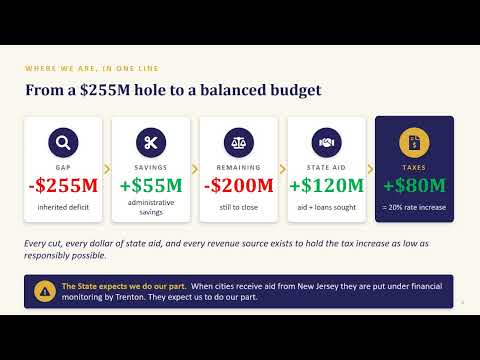
Vicera and Mayor James Solomon said the administration is pursuing three levers: (1) $55 million of ongoing savings and efficiencies already identified; (2) $120 million in historic state aid (a mix of grants and loans) to bridge much of the gap; and (3) a property tax adjustment after other remedies are exhausted. The administration characterized the $120 million as largely an emergency aid package and said it would be the largest state aid package for a municipality in New Jersey's history if approved.
Council members asked for itemized backup and the duration of credit‑card‑style obligations; Vicera said some of the deferred notes go back to 2019–2022 with a concentration in recent years. He said some emergency notes were legally issued in cases that were declared special emergencies, but the repeated use of the practice over multiple years accumulated the debt. Council members asked for transaction‑level details for the $109–110 million of unpaid bills; the administration agreed to provide an itemized breakdown to both the council and the public.
Vicera said the city has also audited some claims submitted to its prior health plan vendor to identify potential overbilling and recovery opportunities but warned that any recovery would likely be a complex, multi‑month legal process.
What council asked for next: council members requested variance reports (budget vs. actual), a detailed itemization of specific unpaid claims and notes, and supporting documentation for the $255 million total. The administration committed to supply those materials to the full council and to the public prior to the July budget hearings.
Speakers quoted: Bill Vicera; Mayor James Solomon.