Get Full Government Meeting Transcripts, Videos, & Alerts Forever!
Get email alerts on the Municipal Budget topic
No spam. Unsubscribe anytime.
Jersey City mayor urges 20% third‑quarter tax rate as city confronts $255 million budget gap
Summary
Mayor James Solomon told the Municipal Council the city inherited a $255 million gap, outlined $55 million in savings and a request for $120 million in state aid, and proposed setting the third‑quarter tax rate at 20% to avoid larger fourth‑quarter increases while protecting core services and seniors.
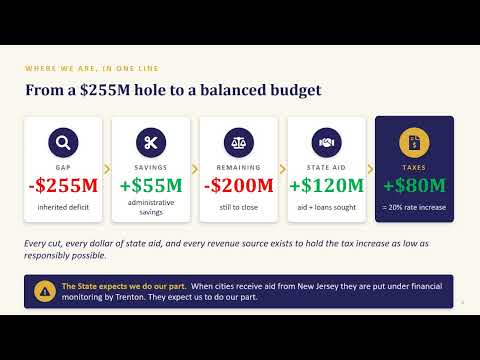
Mayor James Solomon told the Jersey City Municipal Council at a caucus meeting on June 22 that the city faces a $255 million budget gap and presented a plan that combines $55 million in savings, a request for $120 million in state aid, and a proposed third‑quarter tax increase to reduce immediate shortfalls.
"We face basically the biggest fiscal crisis in Jersey City's modern history," Solomon said, listing an inherited set of one‑time revenue uses, unpaid bills and deferred liabilities that now total the $255 million figure the administration presented to the council and to state reviewers. He said administration staffers have produced $55 million in ongoing savings — from a health plan change, staffing controls and other efficiencies — but that a large remaining gap still requires outside aid and revenue adjustments.
Administration officials described the remaining shortfall as two components: about $110 million in deferred or credit‑card‑style obligations (including unpaid healthcare bills) and roughly $90 million in lost recurring revenue after prior one‑time sources were spent. Finance Director Bill Vicera told council members the $110 million represents expenses previously charged and deferred, roughly $52 million of which are unpaid health‑care claims flagged in independent credit‑rating reports.
To address the gap, Solomon said the city has asked Trenton for $120 million in a mix of grants and low‑interest loans, and proposed setting the third‑quarter tax rate at 20% to demonstrate the city's own share of corrective action while avoiding placing the entire burden on a single fourth‑quarter bill. "The state expects us to do our part," Solomon said, framing the request to residents and the council as a three‑part approach: savings, state assistance, then a tax adjustment if necessary.
Solomon emphasized protecting public safety and core services. He warned that eliminating large swaths of civilian departments or deep cuts to police and fire staffing would render city services nonfunctional. "If you were to eliminate basically nearly the entire civilian government of the city, that wouldn't get us to the $80 million that we need," he told the council. He said the administration is designing a budget that prioritizes 911 capacity, police and fire responsiveness, and essential services such as sanitation and snow removal.
Solomon also pledged an expanded outreach program to help seniors on fixed incomes apply for state property‑tax relief programs, saying staff will provide door‑to‑door assistance and in‑person signups for eligible residents. He gave basic eligibility details for the state senior property‑tax freeze: applicants must be 65 or older, own and occupy the home as a primary residence, have household income below roughly $175,000, and file by the program deadline (stated by the administration as Nov. 2).
Timeline and next steps: the administration said the city cannot finalize a full 2026 budget until the state completes its review of the aid request (the administration expected the state process to wrap June 30). The administration plans to introduce the detailed budget on July 15, hold two weeks of public council budget hearings, and adopt the budget in August; setting the third‑quarter tax rate at the council's Wednesday meeting was framed as an intermediate step to give residents notice and to avoid a larger single fourth‑quarter increase.
Council members pressed administration officials for more detailed documentation and line‑item breakdowns, and asked for itemized lists of deferred bills and the timetable for payments. Finance staff said some of the deferred obligations date to 2019–2022 practices and had been noted by rating agencies. Officials said they have provided the state's review team the numbers being discussed and will publish additional variance and department‑by‑department budget vs. spending reports on request.
What this means for residents: the 20% third‑quarter rate is a proposed administrative recommendation intended to spread a burdensome adjustment across two bills rather than concentrate it in the fourth quarter; if the state aid package arrives or the council modifies the budget during July and August hearings, the final fourth‑quarter rate could change. The council and administration said they will continue to search for additional revenue sources and efficiencies, and emphasized transparency in forthcoming line‑by‑line budget materials.
Speakers quoted: Mayor James Solomon; Finance Director Bill Vicera; Council President Ridley.