Get Full Government Meeting Transcripts, Videos, & Alerts Forever!
Get email alerts on the Police Consolidation topic
No spam. Unsubscribe anytime.
Chiefs propose regional "Tri‑Line" police department to address staffing shortfalls
Summary
Three area chiefs presented a proposal to combine Winthrop, Gaylord and Gibbon police services into a single "Tri‑Line" department aimed at improving recruitment, retention and 24‑hour coverage; council members pressed for details on coverage, charter requirements and public input and took no vote.
Chiefs from Winthrop, Gaylord and Gibbon presented a draft plan to form a regional "Tri‑Line" police department, telling the Gaylord council the idea is intended to address a recruiting and retention crisis among small‑town departments.
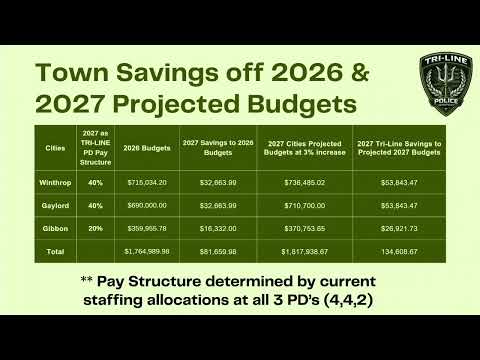
"This is a project about long term sustainability of local law enforcement in our region," Chief Anderson of the Winthrop Police Department said, summarizing the chiefs' pitch that combining resources would preserve institutional knowledge and offer career and pay opportunities that smaller standalone departments currently struggle to provide. The chiefs showed a high‑end, line‑by‑line 2026 combined budget of about $1,765,000 and an updated League of Minnesota Cities estimate of about $1,683,000; they projected 2027 costs at roughly $1.8 million and estimated annual cost‑saving potential approaching $134,000 when compared to current, separate budgets.
Proponents said the model would reduce redundancies — shrinking the combined full‑time officer allocation from 10 to 8 in the proposal — while creating overlapping, roaming coverage across the three towns and a $100,000 CapEx/savings account to cover start‑up capital expenses. "3 communities, 1 department — stronger together," Anderson said, presenting the project as a way to retain officers who otherwise might leave for nearby jurisdictions.
Council members and staff raised detailed operational and legal concerns. Several council members said they were worried consolidation would reduce visible local patrols and community policing, increase reliance on mutual aid or the county sheriff, and could make staffing and coverage worse if officers left after consolidation. One council member argued that "when you start talking about not having that car in town like it is now, it's a big deal to people," emphasizing residents’ desire to see regular patrols in town.
Officials also noted a possible city‑charter constraint. Staff said the charter contains provisions about maintaining a police department and that any charter amendment could require a public hearing and, in some cases, a high council vote or a public vote; council members said the charter and public input should be resolved before any final decision. A staff member also reported the county sheriff's office had quoted a contracting rate of $68 per hour when asked about alternatives.
Council members pressed for clarity on how officers would be scheduled day‑to‑day, how city ordinances and specialized local knowledge would be preserved, how revenue streams such as forfeitures or license fees would be treated, and what start‑up and exit costs might be. The chiefs said they had built conservative, high‑end estimates and planned cross‑training so officers would learn each municipality's ordinances; they also proposed that the joint powers board would set personnel policies and that a rotating mayor/president structure would ensure representation from each town.
Staff proposed a timeline to share draft joint powers agreement language in June for council review, revise it in July and seek council approvals in the July–August window with an aim toward implementation in January 2027. Several council members said that schedule felt too aggressive and urged broader public outreach — on‑the‑ground meetings, handouts and open houses — before advancing policy changes. No formal action or vote on consolidation was taken at the work session; the council agreed to bring the item back to a regular meeting for further discussion.
The council approved the evening's agenda and later adjourned after a motion carried by voice vote. The next procedural steps proposed were staff drafting joint powers language and scheduling a public engagement plan for council consideration.