Get Full Government Meeting Transcripts, Videos, & Alerts Forever!
Get email alerts on the Civic Engagement topic
No spam. Unsubscribe anytime.
Local leaders mark 250th anniversary by urging civic engagement and practical leadership
Summary
A Shore Leadership panel in Easton, Talbot County, used the 250th anniversary to connect founding ideas to local action, with panelists citing regulation, workforce training and AI as top challenges and urging collaboration, mentorship and community‑level engagement.
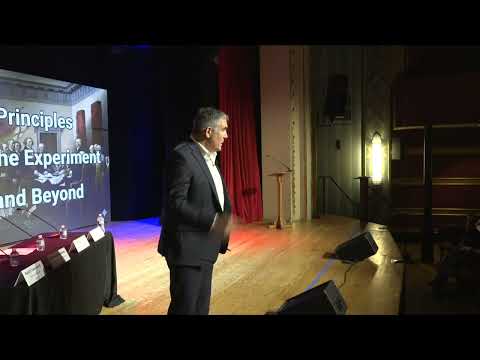
Doctor Joe, identified in the transcript as the event moderator and introduced onstage as "Doctor Joe," opened a Shore Leadership panel in Easton by tying the 250th anniversary of the nation to a discussion of the “first principles” that shaped the United States. He framed the evening with a history lesson and a practical charge: the future of American democracy depends on civic organizations and local leadership, not only national headlines.
"We are not descended from fearful people," Doctor Joe said, arguing that a long history of debate and contesting ideas is part of the U.S. tradition rather than proof of irreversible decline. He reviewed six Enlightenment‑era works — from Hobbes' Leviathan and Locke's Two Treatises to Montesquieu, Rousseau, Voltaire and Adam Smith — and connected those philosophies to the Declaration of Independence and the Constitution, which he described as the nation’s “vision statement” and instruction manual.
The panel featured four local leaders. John Horner, president and CEO of Eastern Utilities, emphasized team‑based leadership and the community role of a locally owned utility. Amy Wilson, a commercial banking executive with Burke & Herbert Bank, said regulatory constraints complicate financing and lending at the community level and pointed to local workforce programs as part of the solution. Savannah Winston, founder and CEO of Vantech Bend Solutions and a former president commissioner of Preston, Maryland, spoke about bringing resources into towns and about mentorship; she noted she is a candidate for Caroline County commissioner. Butch Townsend, regional president for Shore United Bank, stressed that leaders must adapt with changing technology and recruit the right people around them.
On audience questions, Wilson described a Caroline County resource center being launched to help residents build résumés and skills for local jobs. Townsend called technology the "biggest challenge" for many leaders and urged ongoing learning and delegation. On AI, Horner and other panelists said organizations must balance the technology’s promise with careful guardrails and staff training; Horner reported internal policy work to define acceptable use.
Panelists repeatedly pointed to mentoring and next‑generation leaders as sources of optimism. Wilson and others described mentoring programs and the Maryland Service Corps as concrete examples of local efforts that prepare young adults for careers. Drawing on Alexis de Tocqueville’s Democracy in America, Doctor Joe said the ‘‘point of action’’ for a healthy representative democracy lives in towns like Easton and in community institutions: "The magic happens here at the local level," he said.
The program closed with sponsor acknowledgements from Shore Leadership staff and a call for continued engagement; organizers asked attendees to stay for networking and photographs. No formal votes or policy actions were taken during the event.
The discussion mixed historical interpretation with practical community recommendations: panelists urged collaboration among banks, businesses, nonprofits and local government, recommended workforce training and resume help, and cautioned about the rapid rise of AI while noting ways to institute guardrails and internal training.