Get Full Government Meeting Transcripts, Videos, & Alerts Forever!
Get email alerts on the 600 Boardwalk Rehabilitation topic
No spam. Unsubscribe anytime.
Ocean City council adopts rehab designation for 600 Boardwalk after heated public debate
Summary
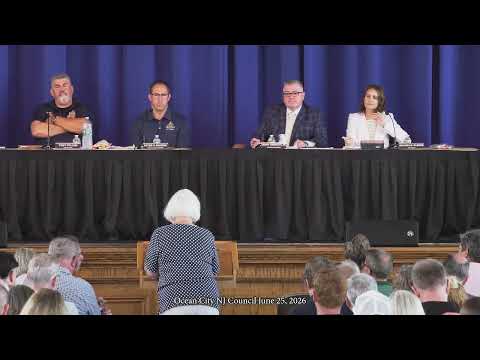
After hours of public comment and council debate, Ocean City City Council approved Resolution 26-197 to designate 600 Boardwalk as an area in need of rehabilitation, a procedural step that allows the city to draft a redevelopment plan. Supporters said the move starts a city-controlled process; opponents urged delay until the newly elected council is seated and raised conflict concerns.
Ocean City City Council voted June 25 to designate the parcels at 600 Boardwalk as an area in need of rehabilitation, setting in motion a city-led process that can lead to a redevelopment plan.
Supporters — including business groups, boardwalk merchants and several council members — argued the designation is a procedural prerequisite for the city to take control of planning for the site and to negotiate what could replace the former Wonderland Pier. "Please vote yes to rehab," said Wes Kazmark, speaking for Business and Neighborhood Development, the Tourism Commission and the Boardwalk Merchants Association. Several council members said they accept the three independent planners27 opinions that the statutory criteria were met and that the designation merely starts a city-controlled planning and negotiation process rather than approving any specific project.
Opponents and many residents asked the council to delay action. Attorney Matthew Velicco, representing the Plaza Place Civic Association, requested that the resolution be considered for discussion only and urged council to refer the subcommittee and planner reports to the planning board for further review. "A vote on this resolution tonight disenfranchises the very voters that elected the new council," Velicco said, noting the newly elected council member is scheduled to be sworn in July 1. Several speakers likewise urged tabling so the incoming council can participate.
The hearing also included repeated allegations and counter-claims about conflicts of interest. Multiple speakers referenced business ties and court filings they said might bear on the record; one speaker identified the property owner by name in testimony. Council members and others disputed or called for verification of those assertions during the meeting. The record before council includes at least three professional planner reports and public exhibits provided to council and the planning board.
City solicitor John Ridgeway told the council that a rehabilitation designation is a statutory step: "There is no statutory authority to develop a redevelopment plan for the property unless it's been designated as an area in need of rehabilitation." He emphasized that any redevelopment plan would be drafted by the city and, if adopted, would go to the planning board for review and public hearings.
After extended debate, council moved to adopt Resolution 26-197. Members speaking from the dais said the designation would allow city officials to negotiate with the property owner from a position of defined public authority and to write a redevelopment plan that includes conditions on height, entertainment and public access. Opponents warned the declaration could be used by an owner seeking variance relief and could invite litigation; proponents countered that city control over a redevelopment plan provides greater leverage to secure public benefits.
The council recorded a roll-call adoption of the resolution. City staff and the solicitor said the next steps — if a redevelopment plan is prepared — would include appointment of a redevelopment committee, drafting of a plan by the city or planning board, public hearings, and additional council action before any site-specific approvals occur.
The council27s vote ends a months-long public process that included a boardwalk subcommittee report recommending zoning and conditional-use tools, a planning-board review and multiple planner reports. Speakers on both sides said the subcommittee27s recommendations should influence the next steps: supporters asked that its standards guide negotiations and any plan; opponents urged formal planning-board review and a broader master-plan approach before the city changes designation.
The council27s action does not itself approve construction, demolition or development. Any redevelopment plan drafted by the city would be subject to further public notice, planning-board review, and additional council votes.
Next procedural steps identified by the solicitor include drafting a redevelopment plan, potential appointment of a redevelopment committee, and public hearings at the planning board and council before any site-specific approvals. Council members said they expect to use the boardwalk subcommittee27s recommendations as guideposts in negotiations and plan drafting.