Get Full Government Meeting Transcripts, Videos, & Alerts Forever!
Get email alerts on the Permits And Inspections topic
No spam. Unsubscribe anytime.
Mount Lebanon officials say permit reviews about 20% faster after online portal launch
Summary
Buildings staff told commissioners that the town issued roughly 4,500 permits since 2022 and that the Municity online portal (launched June 2025) has produced faster review times, while commissioners asked for clearer metrics and consideration of a permit-tech position.
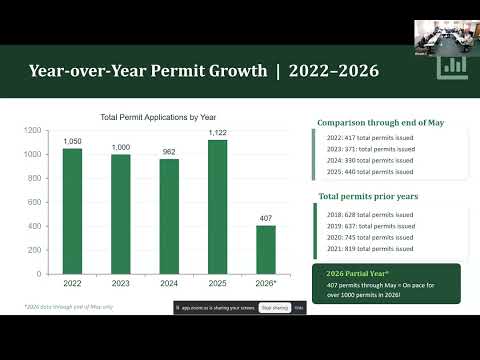
Mount Lebanon buildings staff told commissioners on June 23 that the municipality has issued roughly 4,500 permits since 2022 and that the new Municity online portal, launched in June 2025, has sped internal review times by about 20 percent.
"We're running about greater than 20% faster review time since we've started using Municity," Rodney said as he reviewed four and a half years of permit and inspection data. Staff said the portal allowed the town to standardize data and better measure turnaround across permit types.
The presentation showed the town averaged about 1,000 permits per year since 2022 and had issued 407 permits through the end of May 2025. Staff reported about 3,291 inspections in 2025 and roughly 1,254 so far this year. Standalone zoning permits — typically fences and driveways — were a small share (13%) but staff said 80% of those were issued in under two weeks and 96% in under three weeks, with an overall average of about 10 business days.
Staff attributed many of the remaining delays to incomplete applications and legacy survey documents. "A lot of times we'll download the property survey with the construction documents and compare them on our screens and start to review. Well, it's a lot of times you go into a labeled document and they aren't what they are labeled to be," Rodney said, noting that older surveys can be more accurate in some cases.
Commissioners pressed staff for clearer metrics that separate the time the municipality holds an application from the time an applicant delays resubmission. "It might be better to have a range because what you're talking about, I mean, if a project that's $650,000 is a lot different than a $40,000 bathroom," a committee member said, urging a breakdown by project scale. Staff responded they will attempt to record and report municipality-held time versus applicant-held time so decisionmakers can "compare apples to apples."
Staff also proposed additional applicant education — handouts and short instructional videos — to reduce errors in online submissions and said they may recommend hiring a permit technician or plans examiner if application volumes remain high. "If we continue to get as many applications as we need, an additional staff member would be good," Rodney said, adding that a permit‑tech would vet applications for completeness before plan review.
On automation, staff said current AI tools assist applicants with submission completeness but are not yet mature enough to perform full code-compliance plan reviews for complex local amendments.
Next steps: staff will return with time‑in‑hand versus time‑awaiting‑applicant metrics, and the commission will use that information to decide whether to invest in more technology or add personnel.