Get Full Government Meeting Transcripts, Videos, & Alerts Forever!
Get email alerts on the Referendum Planning topic
No spam. Unsubscribe anytime.
Sparta Area School District board reviews draft survey to gauge support for possible referendum
Summary
Board members reviewed a draft school-perception survey intended to measure voter priorities and test multiple levy/ask tiers, discussed messaging, and asked staff to add clearer tax-impact graphics and website context before a workshop to finalize language.
The Sparta Area School District board spent the bulk of its meeting reviewing a draft school-perception survey designed to inform potential future referendum timing and ask amounts. Mr. Russ, staff member, told the board the district is aiming for a late-September to early-October mailing and stressed the survey should be concise (a four-page target) while linking to fuller explanations on the district website.
The board debated the survey’s structure and tone: whether to offer a multi-tier “menu” of ask levels (examples discussed included $1 million, $1.15 million, $1.5 million and $2 million) or to present tax-impact information with fewer preselected tiers. “We can give tax impact. It might be difficult to say this is what’s going to stay or leave,” Mr. Russ said, urging the board to balance clarity with flexibility.
Mr. Russ also summarized the district’s fiscal context and state policy constraints. He said Act 141 has limited the district’s low-revenue ceiling relative to some peers and cited a per-pupil figure near $11,325; board members noted that other districts are at roughly $11,650 per pupil. Board members discussed an estimated multi-year structural gap the district must plan around and asked staff to include comparative graphs and plain-language explanations on the website.
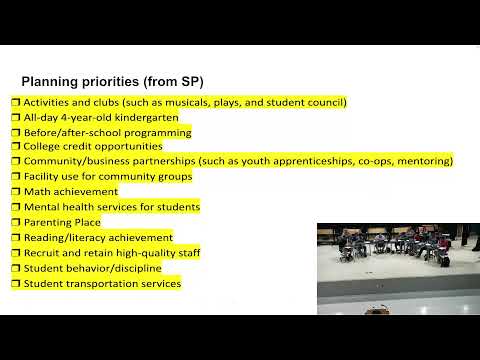
Members pressed for clearer options on the survey’s questions about reductions and priorities. Discussion examples included transportation changes, staffing reductions, reduced co-curricular opportunities, and increases to student fees. Several board members emphasized that any reduction listed in the survey should include a short explanation (and a link) showing real-world examples so respondents understand tradeoffs.
The board directed staff to refine the draft for a scheduled workshop, to produce tax-impact modeling with Baird/Barrett, and to bring updated language and illustrative graphics to the next discussion. No formal referendum ask was set at the meeting; members agreed to return for a workshop that will shape final survey wording and the district’s eventual referendum posture.