Get Full Government Meeting Transcripts, Videos, & Alerts Forever!
Get email alerts on the Infrastructure Planning topic
No spam. Unsubscribe anytime.
Resident urges Bourne to seek MOU with state developers to protect town sewer capacity
Summary
A resident urged Bourne commissioners to ask the select board and sewer commission to request a memorandum of understanding with MassDevelopment and MassDOT to secure sewer mitigation and avoid forcing homeowners to install costly denitrification systems amid large base redevelopment.
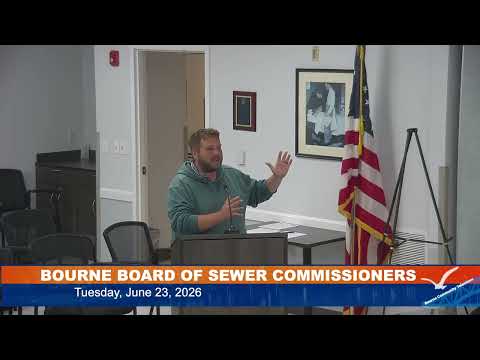
A resident public commenter urged the Bourne Board of Sewer Commissioners on June 23 to press the select board and state partners for a memorandum of understanding to secure sewer capacity and mitigation as redevelopment of the joint base proceeds.
"This is a once-in-a-lifetime opportunity to exert some influence on that redevelopment," the resident Peter said during the public comment period, urging the commission to request an MOU with MassDevelopment and other state entities involved in the Joint Base Cape Cod redevelopment. He said MassDOT and state priorities often focus on moving tourists and commuters and do not prioritize local mitigation.
Peter told the board that the redevelopment involves what he characterized in the meeting as "7,000 acres" on the base and warned that, if a regional wastewater solution is not put in place, local homeowners could face high costs. "We need a sewer solution in this town where residents are going to be forced to put $80,000 denitrification systems into their homes," he said, adding that such costs would be unaffordable for longtime residents.
He recommended the sewer commission write a letter to the select board requesting that the town pursue an MOU with MassDevelopment to secure resources and mitigation planning, and to insist that sewer solutions be considered as part of any base redevelopment.
Commissioners acknowledged the concern and said they would leave related items on future agendas and consider forwarding the request to the select board. The commission noted that conservation and other boards have previously engaged state agencies and that municipal coordination will be important as redevelopment planning continues.
The commissioner and staff discussion that followed referenced a wastewater treatment facility on the base described in the meeting as designed to handle large wartime loads and argued that connecting to existing infrastructure might be cheaper than forcing individual home upgrades.
The board did not take formal action on the public comment at the June 23 meeting but directed staff and commissioners to keep the topic on future agendas as planning proceeds.