Get Full Government Meeting Transcripts, Videos, & Alerts Forever!
Get email alerts on the Stormwater topic
No spam. Unsubscribe anytime.
Richmond DRB approves stormwater upgrades at Riverview Commons mobile‑home park
Summary
The Richmond Development Review Board approved site plan SP2026‑4, allowing Falcon Management to install gravel wetlands and biofiltration structures at Riverview Commons to comply with the state’s 3‑acre stormwater rule tied to the Lake Champlain TMDL. The board said a written decision will follow within 45 days.
The Richmond Development Review Board voted to approve site plan SP2026‑4, clearing a set of stormwater treatment upgrades for Riverview Commons, a mobile‑home park at 68 Fields Lane.
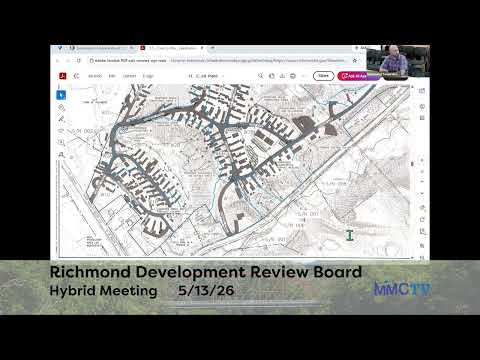
The board’s approval authorizes the installation of gravel wetlands in the center of the park and two engineered biofiltration ("focal point") structures along Summer Street designed to treat runoff before it leaves the property. Applicant representative Chris Rivet, who was sworn before testifying, said the project responds to state requirements tied to Lake Champlain water‑quality goals.
"I was hired by the Department of Environmental Conservation storm water program to…design 3 acre or storm water treatment that meets the 3 acre rule for multiple mobile home parks throughout the state," Rivet said, describing the technical approach and the use of a non‑jurisdictional class‑3 wetland on the site to provide treatment. He explained that one focal point replaces an existing pipe and catch basin and that most discharges will run toward Governor Peek Road and the downstream stream identified in the record.
The project uses a combination of subsurface gravel wetlands — shallow basins with an underdrain and planted wetland soils — and modular biofiltration (R‑tank) systems that the presenter said have been approved by the Vermont Department of Environmental Conservation. Rivet told the board the systems capture sediment upstream and are intended to reduce phosphorus loading tied to the Lake Champlain TMDL; he said routine maintenance and an annual inspection are required and responsibility for upkeep will rest with the park owner, Falcon Management.
Board members pressed the applicant on public‑safety and landscape concerns, asking whether pools would hold standing water and whether fencing would be needed because children use the park. Rivet said the gravel wetland is mainly subsurface and not designed to create large standing pools; he said fencing is typically reserved for deeper ponds and that the design preserves walkable and mowable swales between features.
Rivet also described the regulatory status: stormwater and wetlands registrations and a construction general permit have been issued, a draft state decision is under review (with a small impact fee outstanding), and Act 250 review is in process. He said a draft state decision remains open in part because of pending legislative changes affecting the fee calculation.
After discussion the board moved to approve the application as presented; the chair told the applicant the board will issue a written decision within 45 days.
Next steps: the applicant will proceed toward construction once municipal signoffs and any remaining state items are resolved; the board’s written decision will explain permit conditions and any required follow‑up inspections.