Get Full Government Meeting Transcripts, Videos, & Alerts Forever!
Get email alerts on the Land Use topic
No spam. Unsubscribe anytime.
Preliminary subdivision at 586 Shore Road draws board questions on septic easements and variances
Summary
Developers presented a conceptual 3-lot plan for 586 Shore Road that would rely on easements to place septic fields outside 150-foot buffers; the board urged proof that Title 5-compliant systems and reserve areas could fit on individual lots and noted easement recording, perpetual maintenance and potential Title 5 relief issues.
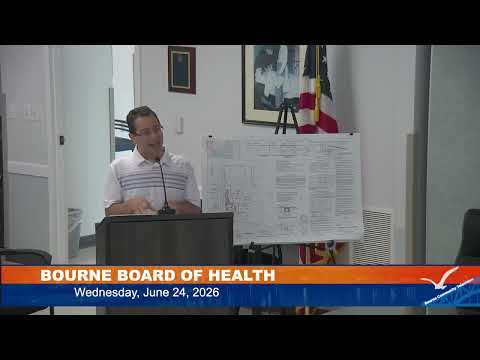
Bourne's Board of Health spent substantial time June 24 reviewing a conceptual subdivision plan for 586 Shore Road presented by Mike Carne of GCG Associates.
Carne said the parcel includes two existing houses (one described as a 10-bedroom) on roughly 4.7 acres between the railroad and Little Bay and that the developer proposes to create three lots. To keep leaching fields outside the board's 150-foot buffer from resource areas, the plan places septic fields on a single lot with easements across lots to allow the other residences to tie into that field. "In order to do the subdivision... we would need to do easements across the lot," Carne said.
Board members and staff pressed the developer to demonstrate on a per-lot basis that a conventional Title 5 system and reserve area could be sited for each new lot if required; staff advised that for variances associated with new construction, easements typically must be recorded in perpetuity and that plans should show that a system could fit on each lot to support variances. Concerns included the site's coastal bank, floodplain, a 10-bedroom house with an undersized current system, and whether easements crossing lot lines for long-term leaching-field access are appropriate and recordable.
Carne said alternative approaches were possible (repairs before subdividing, fewer lots), but noted the plan aims to formalize longstanding access across the owner's property. The board asked staff to draft standard letters to the Zoning Board of Appeals and Planning Board recommending that future filings demonstrate Title 5 compliance for each proposed lot or provide recorded easements if variances are sought.