Get Full Government Meeting Transcripts, Videos, & Alerts Forever!
Get email alerts on the Telecom Zoning And Land Sale topic
No spam. Unsubscribe anytime.
Petersburg assembly advances new wireless zoning rules and approves sale for tower site amid public concern
Summary
After hours of public comment, the Petersburg Borough Assembly passed a first reading of a new wireless-communications zoning ordinance with multiple amendments and unanimously approved selling a 0.23-acre parcel to the Central Council of the Tlingit and Haida (doing business as Tidal Network) for a proposed tower site. Citizens warned of rushed land sales and called for NEPA, engineering and site-alternatives reviews; police and some assembly members said reliable communications are critical to public safety.
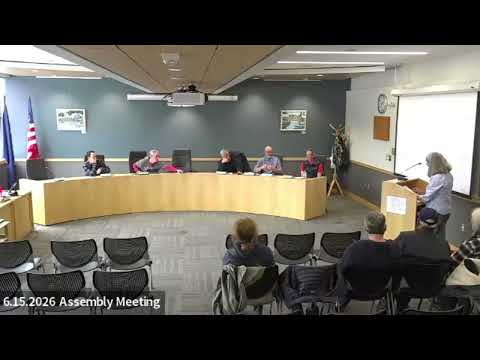
The Petersburg Borough Assembly on June 15 adopted, in a first reading, a new zoning ordinance to regulate wireless communication facilities and voted to sell a borough parcel to the Central Council of the Tlingit and Haida Indian Tribes of Alaska doing business as Tidal Network for a proposed communications tower site.
The ordinance (2026-14) creates permitting and development standards for wireless communication facilities, prioritizes co-location and requires conditional-use review and public notice. During a lengthy first-reading debate the assembly accepted five amendments clarifying that coverage gaps are those of carriers, shortening a planning-commission timing clause, stating that FCC determinations of compliance are controlling, aligning sensitive-area language, and reducing a proposed separation setback from 1,500 feet to 500 feet. The amended ordinance passed its first reading unanimously, 6-0.
The land-sale resolution (2026-16) would transfer roughly 0.23 acre to the tribal consortium to allow construction of a communications facility. Member Mutee, who sponsored the resolution, said he had reviewed borough parcel maps and believed the specific lot under consideration was an appropriate site with benefits for public-safety communications. The assembly approved the sale 6-0.
Why it matters: Borough officials and some residents framed the issue as a tradeoff between community character and public-safety infrastructure. Chief James Kerr, Petersburg’s police chief, told the assembly the principal public-safety benefit: reliable radio and data communications for police, fire, EMS, search-and-rescue and 911 dispatch. "Reliable communications are critical for police, fire, EMS, search and rescue, and 911 dispatch," Chief Kerr said, urging the assembly to secure long-term access for borough equipment on the tower.
Public commenters urged more study. Becky Knight said roughly 300 people signed a petition opposing the proposed towers and a data center and argued the borough should not transfer public land without comprehensive environmental and site alternatives reviews, including NEPA and geotechnical evaluations. "The assembly should not dispose of public land before fully evaluating the impacts of the proposed towers on nearby residents, property owners, public safety, and the environment," Knight said. Judy Omer questioned whether repeated votes on the same parcel were appropriate and asked the assembly to deepen zoning protections for nearby sensitive uses.
Opposition also included broader concerns about privacy and corporate influence. David Beebe, participating by Zoom, called the package of towers and a proposed data center "arguably among the most controversial and consequential matters in borough history" and asked whether the borough’s primary obligation was to residents or to telecom companies.
What the ordinance changes do: The amendments adopted at first reading included the following, as explained on the record by sponsoring members: - Clarify that the ordinance addresses carriers’ coverage gaps rather than an abstract borough gap; - Streamline a conditional-use timing clause to permit planning-commission action without an implied extra public-hearing delay; - Add an explicit sentence that FCC determinations of compliance govern technical RF and related regulatory questions, and the borough will not enforce or interpret FCC technical limits; - Align the ordinance’s sensitive-area language with other sections by replacing certain terms (licensed child-care facility and others) for consistency; - Reduce the minimum separation from specified sensitive uses from 1,500 ft to 500 ft to increase potential siting options and reduce the likelihood carriers pursue waiver requests.
Assembly members stressed this is a first reading and that further legal review and a public hearing are expected. "I support this ordinance as a tool to help us navigate the issue," Member Newman said, noting the borough previously lacked zoning guidance on wireless siting. Member Schwartz warned the body would continue to hear objections, and Member Martin urged staff and members to test federal preemption risks during subsequent review.
Next steps: The ordinance will return for additional readings, public notice and public hearing before final adoption. The land-sale resolution authorizes staff to proceed under the contract terms presented; opponents said they plan to continue to press for engineering and alternatives analysis.
Sources and attribution: Reporting is based on the June 15, 2026 Petersburg Borough Assembly meeting transcript and on direct quotes from public commenters and officials recorded there.