Get Full Government Meeting Transcripts, Videos, & Alerts Forever!
Get email alerts on the Education Funding topic
No spam. Unsubscribe anytime.
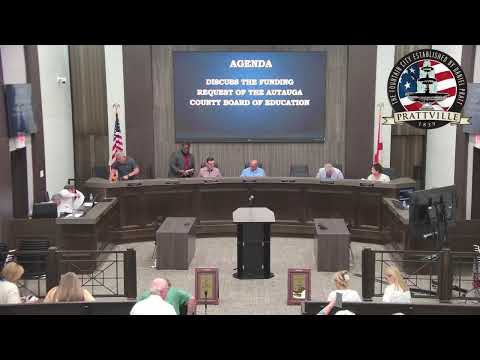
Prattville council weighs reallocation of 1' sales tax and other revenue options to meet school funding request
Summary
Councilors spent much of the session probing how much the city can commit to education after the Autauga County Board of Education requested a clear dollar amount; the finance director outlined 1' sales-tax bucket balances, possible reallocation options and new revenue scenarios while councilors debated city control, bonds and short-term transfers to address facility needs.
The Prattville City Council spent an extended portion of its work session discussing a funding request from the Autauga County Board of Education and what, if any, additional amount the city can commit to education.
Chair read an email from Superintendent Woodfin clarifying that the board needs a single, defined dollar amount the council could commit (the board said $700,000 annually is acceptable if the council cannot support larger sums). Councilors emphasized that knowing a clear figure would shape what projects the board could pursue.
Daniel Oakley, the city finance official, presented the city's 1' sales-tax ("1 cent") bucket balances and commitments. Oakley reported an education reserve balance of about $2.8 million as of the end of May (projected $2.3 million available excluding certain encumbrances) and detailed payments made since the allocation began: roughly $4.2 million to the county Board of Education and about $2.4 million to Central Alabama Community College to date. Oakley said the city currently budgets roughly $700,000 annually for the county board and provides roughly $355,000 in in'kind value for school resource officer salaries.
On potential reallocation and new revenue, Oakley outlined options: reallocating existing public facilities bucket money (some uncommitted dollars exist in that bucket), using lodging-tax or impact-fee changes, pursuing local legislation to even up sales-tax rates across the city where county lines produce disparities, or placing a property'tax or sales'tax measure before voters. He estimated a half'cent citywide sales-tax would yield about $4.7 million annually; a full penny would be roughly $9.4 million citywide. Oakley cautioned against committing more than 75% of a volatile sales-tax stream to fixed, long'term debt.
Councilors expressed differing views about a city school system versus continued support for the county system. Councilor Newman argued the city needs a nimble, city'controlled system to direct dollars to local students and proposed considering reassigning some payments (for example, the SRO allocation) back into an education funding stream. Councilor Chambers (speaker 3) urged a process-oriented approach and proposed a public, joint meeting with the Board of Education, the county commission and Central Alabama Community College to align expectations and funding options.
Councilors also discussed interim options to provide funds this fiscal year: smaller reallocations from uncommitted public-facilities or education miscellaneous buckets, one'time transfers, or departmental temporary spending adjustments (councilors resisted across'the'board cuts that would reduce core public safety and services). Oakley said roughly $1.28 million in the public'facilities bucket could be reallocated in the near term without exceeding his recommended cushion; he also noted ongoing commitments (for example, $400,000 annually toward a "Pratt" project through 2029) would affect available balances.
The council agreed to pursue a public roundtable that would include city, county and school leaders and to ask staff to sharpen numbers on reallocations and potential new-revenue scenarios; no long'term funding decision was made at the meeting.
Representative quotes from the session included the finance briefing and several councilors' positions. Daniel Oakley summarized the education bucket and near'term availability: "The education reserve balance as of May 31 is 2,800,000," and he noted the yearly budgeted allocation to the Board of Education is roughly $700,000. Councilor Chambers urged a deliberative, transparent process: "A project of this magnitude deserves a transparent conversation where everyone can hear the same information, ask questions, and better understand the expectations of each partner." Councilor Newman pressed for local control and new revenue ideas, including reassigning the SRO allocation.
Next steps: staff will inventory uncommitted 1' bucket balances and present refined scenarios for near'term assistance and for long'term financing options prior to a public joint meeting with county and education leaders.