Get Full Government Meeting Transcripts, Videos, & Alerts Forever!
Get email alerts on the Veterans Education Benefits topic
No spam. Unsubscribe anytime.
Guam lawmakers hear bill to let UOG and GCC set rules to implement veterans' tuition benefit
Summary
The Guam Legislature committee on June 25 heard testimony on Bill 335‑38, which would let the University of Guam and Guam Community College adopt institution‑specific rules to implement the Guam Veterans Higher Education Benefits Act; UOG estimated roughly $900,000 in annual tuition waivers under several assumptions, while lawmakers raised concerns about the bill as an unfunded mandate.
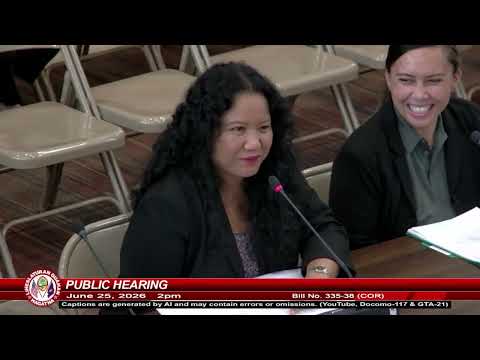
The Committee on Education, Libraries and Public Broadcasting on June 25 heard testimony on Bill 335‑38 COR, which would amend chapter 56, division 5 of Title 17 of the Guam Code Annotated to clarify rule‑making authority and administrative procedures for the Guam Veterans Higher Education Benefits Act (Public Law 38‑99). Senator Vincent Ada Borja, who introduced the measure, said the change is intended to remove implementation barriers that have prevented veterans and their families from using the tuition benefit as intended.
"The bill is about making sure the benefit we created for our veterans can actually be used," Borja said, explaining that the University of Guam Board of Regents and the Guam Community College Board of Trustees would be given authority to establish rules for their respective institutions.
Dr. Virginia Techala, introduced in the transcript as interim president for Guam Community College, testified in support of the bill but recommended a technical amendment. Techala said existing institutional governance places the responsibility to develop administrative rules with college administration subject to board approval, and she proposed revised language to reflect that structure while preserving the committee's intent and the bill's 120‑day adoption deadline.
Ricky Hernandez, vice president for administration and finance at the University of Guam, told the committee UOG supports the bill's intent and provided a rough fiscal estimate and methodology for the committee's consideration. Hernandez said current enrollment figures identify 64 veterans and 164 dependents; using conservative assumptions (applying the benefit to roughly half of that group, 18 credits per semester, and a $221 per‑credit undergraduate rate), UOG estimated an annual value of roughly $900,000 in waived tuition. He repeatedly cautioned that the number is an estimate subject to many variables, including whether veterans have exhausted federal benefits such as GI Bill or Title IV grants.
"That number is to be a moving target," Hernandez said, noting the calculation relied on assumptions about participation and course loads.
Lawmakers pressed witnesses on fiscal and operational implications. Senator Regine Biscoe Lee asked whether UOG and GCC had engaged the Guam Veterans Affairs Office about implementation; both institutions said they had not yet met with that office and were encouraged to do so. Senator Chris Barnett pressed whether the bill — which lawmakers and advocates previously described as an unfunded mandate — would require UOG to raise tuition to cover lost revenue. Hernandez said UOG's most recent year‑to‑year enrollment was stable and reiterated that it was premature to conclude whether the benefit would force tuition increases, because the impact depends on how many current students qualify for waivers, how many new students enroll as a result of the benefit, and whether additional appropriations are provided.
Committee members and witnesses also discussed practical implementation: under the bill's timetable discussed in testimony, each institution would adopt rules within 120 days of the act taking effect; the institutions would begin accepting applications roughly 60 days after rules are adopted, and the program would take effect the next full semester. Testimony emphasized that the benefit would be administered on a space‑available basis and that institutions would consider degree audits, outreach to tuition‑paying students and, if necessary, opening additional course sections only when economically feasible.
The committee invited further written testimony within seven days and closed the hearing at 2:30 p.m. The bill will proceed through the Legislature's process, where committees and the full body may consider amendments and any funding implications.