Get Full Government Meeting Transcripts, Videos, & Alerts Forever!
Get email alerts on the Protective Orders topic
No spam. Unsubscribe anytime.
Senators hear bill to extend protective orders tied to criminal sentences; Judiciary warns of due-process and administrative burdens
Summary
Lawmakers heard testimony on Bill 250-38, which would let courts issue or extend protective orders tied to criminal sentences and require clerk notification to Guam Police Department and Department of Corrections; the Judiciary supported the goal but urged safeguards for notice, hearings and administrative feasibility.
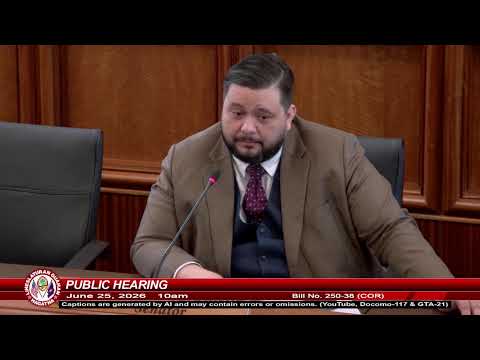
Senator Parkinson opened a public hearing on Bill 250-38, the Victim Protection Continuity Act, saying the measure would close a gap that can leave victims unprotected when an offender's civil protective order expires during incarceration. "When an offender leaves prison, the victim should not be the one left unprotected," the senator said in opening remarks.
The bill would let criminal courts issue protective orders at sentencing in cases involving abuse, harassment, stalking, sexual offenses or threats; automatically extend an existing protective order that would expire while the respondent is incarcerated; and permit the court to issue a new protective order on the offender’s release when warranted. Under the text presented at the hearing, the extension formula is time-based: if the sentence exceeds five years, the order would continue one year after release; if the sentence is five years or less, the order would continue two years after release. The bill also would require the clerk of court to update expiration dates and notify the Guam Police Department and the Department of Corrections.
Why it matters: supporters said the measure spares victims the trauma of returning to court to re-establish protection and gives law enforcement and supervision officers clear, enforceable orders at a critical time. The sponsor framed the bill as "victim-centered justice" and cited peer-reviewed studies finding protective orders reduce subsequent violence and injury over time.
Judiciary officials and court staff who testified supported the bill’s objective but urged changes to preserve due process and avoid imposing unsustainable administrative duties on the clerk. Danielle Rosetti, Administrator of the Courts, said "existing law already allows the court to issue an order long enough to cover incarceration and post-release circumstances where the evidence warrants that relief," and cautioned that automatically extending orders by statute could blur the line between civil and criminal processes and would impose a heavy burden if the clerk were required to track incarceration and release dates and recalculate expiration dates without additional resources.
Lisa Baza, Administrator of Client Services and Family Counseling (a Judiciary clinical division), said the Judiciary’s integrated clinical services and coordinated community response efforts inform a victim-centered approach, and she recommended a clear, accessible, trauma-informed process for review or modification of extended orders so protections remain responsive to individual circumstances.
Carol Henkel-Sanchez, managing attorney at the Civil Law Center (Public Defender's Service Corporation), said her office supports the bill’s intent to prevent re-traumatizing victims but raised concerns that a statutory, fixed-duration extension (1 year vs. 2 years) is not tied to individualized findings of risk and could produce anomalous outcomes. She recommended placing the provisions in the appropriate code sections (Title 7 remedies for family-violence, sexual-abuse and stalking chapters and Title 9, chapter 80 for criminal dispositions), adding a mechanism for victims or the court to request review, and preserving notice-and-hearing safeguards in civil contexts.
Several senators thanked witnesses and stressed a shared goal of protecting victims while avoiding unnecessary procedural complexity. Senator Barnett and others said they would work with the sponsor and the Judiciary to revise statutory language and invited agency partners, including GPD and DOC, to participate in a forthcoming markup. The sponsor said he would schedule a markup hearing, continue to accept written testimony, and work to reconcile operational and due-process concerns.
What happened next: the committee considered the bill "heard" and left the record open for additional testimony; no vote was taken. The sponsor announced plans for a markup session with the Judiciary and stakeholders to refine the bill’s drafting, notice and operational provisions.