Get Full Government Meeting Transcripts, Videos, & Alerts Forever!
Get email alerts on the Education Governance topic
No spam. Unsubscribe anytime.
Guam committee hears mixed views on Bill 286-38 to make education board appointed
Summary
Lawmakers and education leaders sparred over Bill 286-38, which would replace the hybrid Guam Education Board with a primarily appointed board; witnesses cited audit delays, accountability gaps and legal risks while urging clearer removal rules and stronger safeguards against politicization.
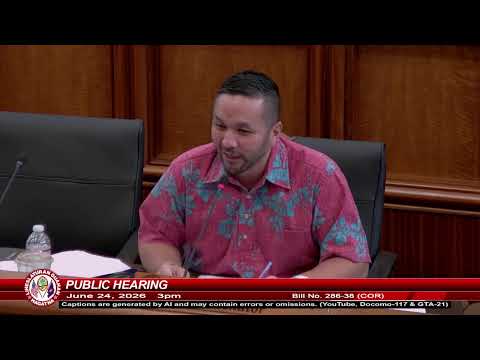
Chairman Senator Vincent A.B. Borja opened a public hearing on Bill 286-38 on June 24, 2026, saying the proposal ‘‘moves away from the current hybrid model and creates an appointed Guam education board’’ to provide clearer lines of accountability and a student voice on the board.
The bill would reduce voting membership and give the governor four appointments (subject to legislative advice and consent), the legislature two appointments, and one youth member chosen by the board. Borja framed the change as a community-driven response to what he called a pattern of management breakdowns and to a delayed 2024 management and curriculum audit required under Public Law 37-44: ‘‘The audit was completed, its findings were discussed, and the legislature and the people of Guam still have not received what the law required,’’ he said.
Supporters from education circles told the committee the appointed model could strengthen governance if it includes clearer appointment criteria and removal procedures. Kenneth B. Chargualaf, a former associate superintendent and past board member, said the bill ‘‘presents an opportunity to strengthen the Guam Education Board’’ but recommended a uniform advice-and-consent process for appointees and reconsideration of narrow youth-member requirements.
Retired GDOE employee Doris Bukikosa said she supported the bill but urged protections for support staff representation and clearer procedures for removing board members who act ‘‘inappropriately’’ rather than leaving removal ‘‘at the pleasure’’ of an appointing official.
A current GDOE staffer, Jordan Bukikosa, voiced worries that the proposed removal language could produce partisan removals and urged a petition- or public-driven mechanism with defined thresholds. He also asked for clearer delineation between board policy duties and superintendent operational authority.
Members of the Guam Education Board defended their work but acknowledged problems. Dr. Judith Guthertz, who said she serves on the board, recommended giving the appointing authority freedom to select needed expertise while considering longer, staggered terms to foster independence; she also pointed to existing external review pathways such as the Ethics Commission and the Attorney General for serious complaints.
Not all witnesses supported the bill. Dr. Ricardo Won Pat warned the committee the measure risks running afoul of the Organic Act by enabling the legislature to exercise direct supervisory control over an executive-branch agency. ‘‘Bill 286-38 comprises an illegal delegation of power to the legislature to supervise the schools,’’ he said, urging a careful review or withdrawal.
Dr. Ron McNinch, an elected board member, offered a range of alternatives and technical fixes, including longer superintendent terms, reduced barriers for candidates, better whistleblower and retaliation training, and consideration of site-based governance models that would give individual schools greater operational control.
Throughout the hearing senators pressed witnesses on why alleged misuse of funds and poor management were not detected earlier by the board. Board members responded that statutory limits restrict board access to some operational data and that many concerning practices only became visible after leadership changes and audit follow-ups.
Senators and witnesses repeatedly debated trade-offs between electoral accountability and administrative independence. Supporters argued appointed members could bring technical expertise and clearer accountability to appointing authorities; opponents said removing elections would cut voters out of board oversight and risk politicizing board composition. Several witnesses urged more public outreach and further drafting work before finalizing the measure.
The committee left no formal vote on the bill at the hearing and invited additional written testimony; Chairman Borja closed the hearing at 5:14 p.m. Interested parties were told to submit testimony to the Guam Legislature offices in Hagatna. The record includes repeated references to 17 GCA Section 3102, Public Law 37-44 and the FY2024 Office of Public Accountability audit, which shaped much of the committee’s questioning and testimony.