Get Full Government Meeting Transcripts, Videos, & Alerts Forever!
Get email alerts on the Municipal Energy topic
No spam. Unsubscribe anytime.
Cumru Township Board authorizes purchase of solar panels for fire station and public works building
Summary
After a presentation and public comment, the Cumru Township Board voted to authorize purchase and installation of rooftop solar for the new fire station and the Public Works building, citing federal incentives and multi-year utility savings; the authorization was a voice vote with no roll call recorded.
The Cumru Township Board voted to authorize purchase and installation of rooftop solar panels for two township facilities — the new fire station and the Public Works building — after a presentation outlining costs, federal incentives and projected savings.
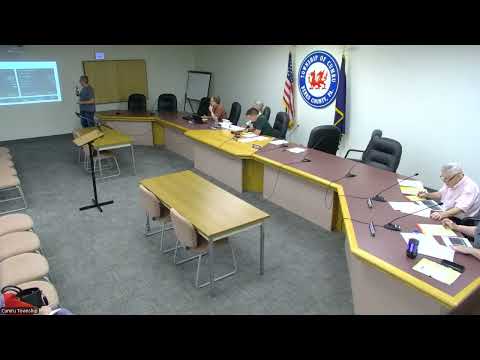
Greg, who prepared the vendor proposals and presented the analysis, told the board the fire-station project has a pre-incentive cost of about $650,000 and the Public Works project about $200,000. He said the Inflation Reduction Act incentives and related credits reduce the township’s outlay substantially: “40% coming straight from the federal government under the Inflation Reduction Act,” plus roughly 10% for Buy-American provisions and an additional roughly 10% for energy-community credits tied to a local power-plant closure, he said. Greg added that the proposals assume the vendor achieves IRA “safe harbor” milestones before a July 5 deadline so the projects remain eligible for the direct-pay incentives.
Using the vendors’ production estimates, Greg said the fire station’s annual electric bill (currently estimated at about $40,000) could be reduced to roughly $3,600 with the panels in place and would generate about $7,500 a year in SREC revenue — a net annual benefit in the mid-$40,000 range. He estimated the Public Works building would yield about $8,400 in net annual benefit after SREC revenue. Greg summarized the long-term case this way: the township’s most conservative comparison would be roughly $522,000 all-in under a 10-year TELP finance structure versus an estimated $2.2 million in utility payments over 30 years, with an estimated lifetime savings on the order of $1.7 million.
On financing, Greg recommended a 10-year TELP to match current electric spending and noted the TELP structure would require moving about 0.05 mils (about $47,000 on current budgets) from the general fund into an in-service fund to service the debt for the ten-year term. He recommended targeting installation in March to capture the full annual production cycle and to give vendors time to refine system size after more months of fire-station usage data.
Public commenters raised technical and procurement concerns. Ronald Schmell, a resident, urged caution about roof loading on pre-engineered metal buildings, snow-load calculations and insurance implications, and suggested a ground-mounted array on township-owned land as an alternative to placing panels on the fire station’s varied rooflines: “pre-engineered buildings can't hold weights on the roof” and he warned about insurance and leakage concerns if the roof is drilled. Greg and other officials responded that vendors arrange structural engineering checks and that installers often use clamps for standing-seam roofs rather than drilling into panels; they also noted warranties and inspections are part of the vendor process.
Another commenter, Mr. Notestine, urged pursuing competitive advertised bids rather than relying solely on the state Co-Stars contract, arguing that a widely advertised competitive process tends to produce lower prices; township staff said the accelerated timeline tied to the IRA safe-harbor limited the time available for an advertised bid, which influenced the decision to use a Co-Stars procurement option for speed.
A resident asked whether battery storage would be included; Greg said he was not recommending batteries at this time because they do not yet provide a compelling financial return and have replacement-cost issues over a 12–15 year life span.
Board members asked procedural questions about next steps. Staff said that if the board authorized the project, Peter would sign contracts and vendors would begin issuing purchase orders and warehousing equipment as needed to meet the safe-harbor milestones; structural engineering and other preparatory work could begin sooner. A citizen noted that some panel manufacturers operate U.S. facilities (Q Cells facilities in Dalton and Cartersville, Georgia were mentioned) in support of the Buy-American eligibility claim.
The chair asked for a motion to move forward with the purchase and installation; an unnamed member moved, another seconded, and the board approved the authorization by voice vote (no roll-call tally was recorded). The meeting then adjourned.
Next steps: staff will execute vendor contracts and begin the procurement steps needed to secure IRA safe-harbor milestones; the board discussion indicated installation would be scheduled to maximize first-year production if vendor timing allows.