Get Full Government Meeting Transcripts, Videos, & Alerts Forever!
Get email alerts on the Telecommunications topic
No spam. Unsubscribe anytime.
Board denies setback variance for proposed 195‑foot communications tower along Highway 139
Summary
The BZA rejected a variance request to reduce the tower setback by relying on an engineered fall zone, citing nearby residential impacts and lack of demonstrated hardship; the applicant said no collocation options were available within two miles.
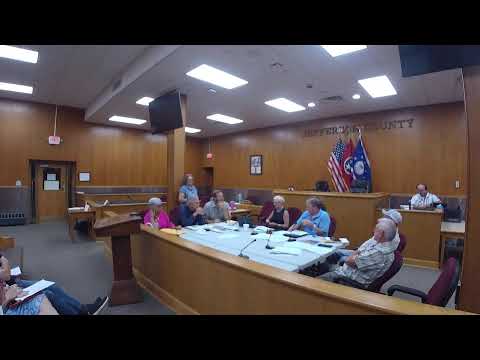
The Jefferson County Board denied a request on June 23 for a reduced setback on a proposed 195‑foot monopole wireless tower along Highway 139, rejecting the applicant’s argument that an engineered fall zone would provide an acceptable safety margin.
Vogue Towers project manager Michael Santafer, representing a Verizon-led need, described a 195‑foot monopole intended to host multiple wireless carriers and said the company offers space for local emergency agencies at no charge. He said the project team searched within the statutory radius and found no suitable existing structures for collocation, explaining that strict 150% setback rules and the county’s requirement that a tower be a primary use left few viable parcels.
“Vogue Towers is proposing a new multi‑provider wireless communications facility including a 195‑foot monopole structure,” Santafer told the board, outlining technical traffic forecasts and a photo simulation package.
County planner Katherine Baldwin and other staff raised visual and neighborhood impacts, noting the site is immediately adjacent to residential properties and that the 150% setback standard (adopted in 2000) appears designed to require a larger parcel or different siting. Baldwin cited a prior denial of a similar variance in 2019 and said that shortened setbacks risk harmful off‑site impacts; she also questioned whether the applicant had demonstrated the kind of land‑based hardship that supports a variance.
Board members cited the residential context and existing precedent in voting to deny the variance. The denial means the planning commission item related to this tower will not proceed while the variance remains denied, and the applicant must either find a conforming site, seek a different variance through the county commission process, or withdraw the project.
Santafer had offered engineering evidence about the engineered fall zone — the pole is designed to kink and fail within a controlled lower portion — and provided FAA no‑hazard documentation and photo simulations. But the board concluded that potential impacts on adjacent yards and the absence of a demonstrated land hardship outweighed the applicant’s arguments for relief.
The motion to deny the variance carried by voice vote; staff recorded the outcome and the planning item tied to the variance has been removed from further consideration pending any revised submittal.