Get Full Government Meeting Transcripts, Videos, & Alerts Forever!
Get email alerts on the Municipal Budget topic
No spam. Unsubscribe anytime.
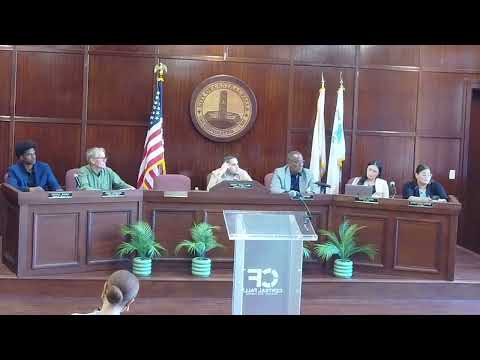
Central Falls council hears FY27 law department priorities, approves first readings for budget, salaries and capital program
Summary
At a special meeting June 1, the Central Falls City Council received the law department's FY2027 budget presentation, including a reorganization that merges three coordinator roles into a part‑time legal coordinator, and passed first-reading motions on the FY2027 operating budget, a salaries ordinance, a wage-schedule amendment and the capital program (voice votes recorded as passing).
The Central Falls City Council on June 1 heard the Central Falls Law Department's FY2027 budget presentation and approved several ordinance items on first reading, including the annual operating budget, a salaries ordinance, a wage-schedule amendment and the annual capital program.
Solicitor Jersey presented the law department proposal, describing staffing changes that consolidate the lead-poisoning-prevention coordinator, domestic-violence task-force coordinator and nuisance-task-force coordinator into a single part-time "legal coordinator" position. "We have moved the position of the lead poisoning prevention coordinator, the domestic violence task force coordinator...and created a new part-time position called legal coordinator," Solicitor Jersey said, and identified Kimberly Pineda as the staff person expected to move into the part-time coordinator role.
Jersey said the restructuring aims to ensure a licensed attorney and a Spanish-speaking staff member handle lead, nuisance and domestic-violence issues. He also highlighted department priorities tied to the mayor's agenda, including contracts, neighborhood boundary disputes associated with the new high school, housing acquisition strategies (such as receivership), and legislative work at the statehouse. Jersey reported the city has four priority bills at the state level, including legislation tied to the high school financing and a "local control" bill; he said the local-control provision was included in the state budget and would return school control to the city once the budget becomes law, "which should be sometime between June 18th and July 1."
Council members questioned salary ranges for the new coordinator role, how the 200-unit housing goal is being counted (cumulative projects vs. additional units), revenue recoveries from code enforcement and the appearance of a typographical error in the HR pay line. Jersey responded that the 200-unit figure aggregates projects currently tracked (for example, about 65 units at School Street) and said revenue from lien and housing-court enforcement has produced roughly $17,000 so far in the fiscal year; he also confirmed a $5,000 proposed raise for the deputy director of human resources and noted a packet typo was corrected.
After the presentation and question period the council took up scheduled bills. The clerk called motions to approve the FY2027 annual operating budget ordinance (first reading), the ordinance pertaining to department head salaries (sub A), an ordinance amending the wage schedule (first reading) and the annual capital program and capital budget (first reading). Each motion was seconded and passed by voice vote; the clerk announced each motion "passes" with six affirmative responses recorded in the meeting.
These votes were recorded as first readings and administrative approvals at the meeting; the transcript records the council's procedural approval but does not show full roll-call tallies tied to individual councilmembers for each motion beyond the announced passage. The council closed by approving the journal and adjourning the special session.
Next steps noted in the meeting: these are first readings or procedural approvals in the current session; additional hearings, amendments or formal roll-call votes may occur on subsequent agenda schedules as required for final ordinance adoption.