Get Full Government Meeting Transcripts, Videos, & Alerts Forever!
Get email alerts on the Grants And Funding topic
No spam. Unsubscribe anytime.
Regional planner urges household survey to boost Emmet’s grant eligibility; council authorizes forms
Summary
A regional planner told Emmet leaders the town’s low‑to‑moderate‑income (LMI) share is well below the typical 51% threshold and advised a door‑to‑door anonymous household survey to re‑estimate LMI. The council authorized staff to obtain forms and proceed with mapping and distribution work.
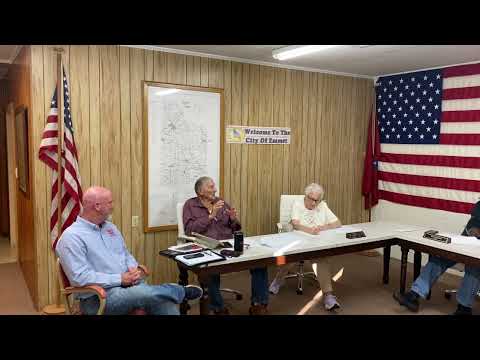
Mr. Jay Clark, a representative of Southwest Planning and Development in Magnolia, told the Emmet City Council that the town’s most recent LMI (low‑to‑moderate‑income) figure falls well under the 51% threshold that many federal and state programs use to prioritize funding. "The last LMI figures generated for Emmet came back way under the 51% threshold," Clark said, adding that the town’s reported share is in the low‑to‑mid 30s.
Clark explained that LMI percentages are calculated from U.S. Census and American Community Survey data and can fluctuate. He recommended a community survey in which each household completes a numbered, anonymous form that planners would tabulate to produce temporary LMI figures. "The survey is completely anonymous. Every house would have a number," Clark said, noting that the resulting LMI estimate would be valid for roughly two years.
Council members asked logistical questions about the forms and map. Clark said his office can work with the town engineer to generate a numbered map (assigning a number to every livable structure) and to print forms for distribution. He warned nonresponses count against the town’s tally and said door‑to‑door follow‑up may be required for households that do not return forms. If completed by the end of July, Clark added, his office could still assemble an October application for certain water‑program grants; otherwise the town could aim for a 2027 cycle.
At the meeting a council member described the town’s urgent equipment needs — notably a 30‑year‑old trash truck with multiple leaking hydraulic cylinders that the member estimated would cost about $20,000 in immediate repairs and could need more soon. Clark said he would investigate non‑LMI‑dependent options as well, including Arkansas Division of Rural Services matching grants and AEDC block grants. "Rural Services has some great grants," Clark said; he also agreed to ask whether any AEDC programs might fund a truck rehab or purchase.
After discussion, a motion was made, seconded and approved to authorize town staff to obtain the household survey forms, work with the engineer to prepare the map, and proceed with the survey process so Emmet can test whether revised LMI figures would make it eligible for additional grant programs.
The council did not commit city funds in the motion; Mr. Clark said smaller grant applications often have minimal administration fees, while larger grants typically allow a 10% administrative fee and engineering costs that vary by project. He also said some grant programs are not LMI‑dependent and could be pursued regardless of survey results.
Next steps: the council authorized staff to accept the forms and begin the mapping and distribution process; the town will return to a future meeting with more detail on costs and timelines once mapping and procurement planning are under way.