Get Full Government Meeting Transcripts, Videos, & Alerts Forever!
Get email alerts on the Programs Landscape topic
No spam. Unsubscribe anytime.
EY Parthenon tells LA Unified board where program deserts and waitlists exist; recommends targeted expansions and community-driven planning
Summary
Consultants presented a districtwide program landscape analysis to the Los Angeles Unified School District board, identifying program deserts, waitlists for advanced learning, and uneven program distribution; recommendations center on expanding high‑demand options, improving enrollment navigation and conducting deep community engagement before any school‑level changes.
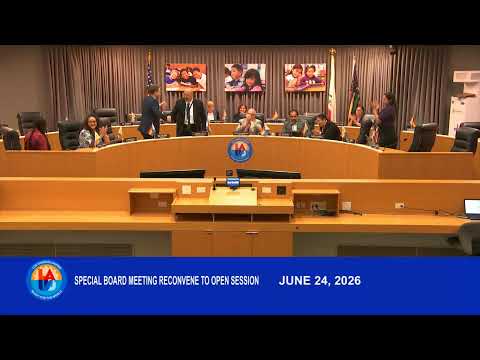
The Los Angeles Unified School District board on Monday heard the findings of a districtwide program landscape analysis conducted by EY Parthenon, which cataloged program availability, demand and coherence across 41 neighborhood clusters and 17 larger “ecosystems.” The consultants said the review is intended to inform future decisions — not to order school closures — and recommended targeted expansions of high‑demand programs alongside community engagement and further analysis.
"This work and analysis has been going on now for months. It's never been and nor is it now about school consolidations," Carolyn Speight Gonzales, the district's chief of staff, told the board as she introduced the consultants' presentation. EY Parthenon said the engagement included more than 4,300 community participants, 1,100 LAUSD stakeholders (including 745 principals), about 290 non‑LAUSD families and more than 40 community partners.
The analysis used five dimensions to score program strength — availability, coherence, academic growth, demand and retention — and aggregated results by neighborhood cluster and ecosystem. Findings included: parts of the district with strong program mixes and coherent pathways showed higher school utilization and higher academic growth; other areas had program deserts (notably a shortage of middle/high advanced learning options in some neighborhoods), and some neighborhoods suffered program saturation at elementary levels that diluted demand across many similar offerings.
Consultants highlighted three program types that surfaced repeatedly in community feedback and data analysis: advanced learning options (AP/IB/dual enrollment and gifted pathways), career readiness (CTE and linked learning), and arts/enrichment programs. In areas with waitlists — frequently for advanced learning and specialized academic options — the firm recommended expanding seats where space exists or replicating successful programs in neighborhoods where demand originates.
The report also flagged areas with low demand relative to local program supply and suggested the board consider targeted consolidations or reconfigurations at elementary grades where many similar programs exist in close proximity and overall enrollment has declined.
Board members pressed the consultants and staff on next steps, equity and execution. Several asked for the raw waiting‑list and application data to determine where applicants live and whether seat expansions should be sited closer to home. One board member noted the district's recent fiscal stabilization plan that requires $60 million in footprint reductions and asked how that pressure intersects with program planning.
EY Parthenon emphasized execution risks: program additions require funding, staffing with specialized instructors and detailed community engagement. The consultants recommended developing a prioritized implementation plan, sequencing recommended actions, and pairing program changes with work to simplify and clarify the district's enrollment process so families can find and apply to options more easily.
What happens next: consultants and district staff said this analysis is a first step; the district will conduct deeper data dives, more community engagement and planning work before any school‑level or facility decisions are proposed. The presentation noted that any program additions or changes would require significant additional analysis and public vetting before implementation timelines (possible actions targeted to the 2027‑28 school year) could be finalized.