Get Full Government Meeting Transcripts, Videos, & Alerts Forever!
Get email alerts on the Homelessness topic
No spam. Unsubscribe anytime.
Residents press Bangor council on homelessness, committee conflicts and public-safety impacts
Summary
Multiple residents used public comment to press for better data, conflict disclosures, and more effective homelessness responses; the council amended the advisory committee’s mission (26-194) and agreed to expanded stabilization planning.
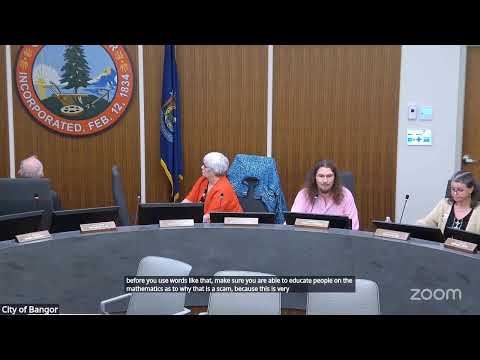
Public comment at the June 22 Bangor City Council meeting was dominated by homelessness, visible drug use and sanitation concerns, with multiple residents urging the council to improve oversight, disclosure and measurable outcomes.
Speakers described needles on school property, open drug use in parks, vandalism of downtown facilities and failures in management at some housing sites. Rachel Ortiz, an educator and resident, said she had "personally found and photographed hundreds of discarded needles on school property" and asked the council: "How much money has Bangor spent addressing homelessness over the last 5 years? and what measurable outcomes have taxpayers received from those investments?" She urged clear benchmarks rather than anecdotes.
Philip Henry questioned how the homelessness advisory committee was constituted after the May 27 appointments, observing that most of the nine seats were held by people employed by organizations that receive city homelessness or opioid funding. He asked the council to direct all nine members to file conflicts-of-interest disclosures, to request the city solicitor publicly advise on which members should recuse themselves and to appoint two or three independent members to ensure public confidence.
Other speakers called for concrete actions: Scott Party urged removal of downtown public restroom units he described as unsanitary and used for drug activity; Rebecca Campbell sought consistent enforcement in parks and publication of performance data tied to contracts and syringe-service programs; Grace Nichols (ACT UP Bangor) urged empowering the advisory committee to act quickly on transitional housing and supervised campground models to link people with services.
Council action connected to the topic: the council voted unanimously (8–0) to amend the municipal code to modify the mission of the advisory committee on homelessness (ordinance 26-194) to explicitly include stabilization planning and allow council referrals for immediate issues.
Public requests recorded during the hearing included conflict disclosures, a public explanation of how city and federal funds align with new HUD guidance, and measures to track needle-disposal outcomes in coordination with health agencies. Several commenters asked for independent oversight and more residents with lived experience on advisory bodies.
What happens next: the council passed ordinance 26-194 to broaden the advisory committee’s mandate; residents asked for written responses and public disclosure on conflicts and funding alignment, items councilors said staff and the solicitor would follow up on.