Get Full Government Meeting Transcripts, Videos, & Alerts Forever!
Get email alerts on the Municipal Budget topic
No spam. Unsubscribe anytime.
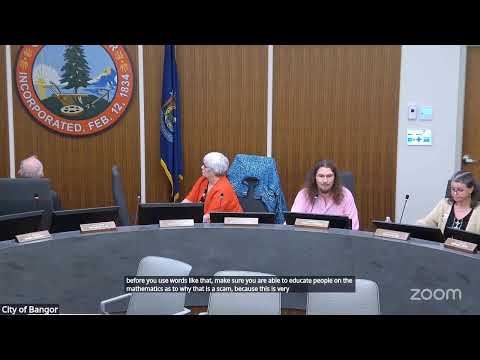
Bangor council adopts FY 2027 municipal and school budgets amid debate over reserves and staffing
Summary
The council passed the municipal budget as amended and a package of school funding resolves on June 22, 2026. Debate centered on use of $10.8 million from reserves, a projected average residential tax increase, and new staff positions intended to address public-safety and service shortfalls.
The Bangor City Council on June 22 approved the city’s municipal budget for fiscal year 2027, after amendments and lengthy public comment about tax increases and the use of reserves.
Councilors passed the amended municipal appropriation (resolve 26-204) by a 5–3 vote. The package included appropriations totaling multiple municipal and school-line items; council also approved capital appropriations (resolve 26-205) and a suite of school budget resolves that collectively fund the Bangor School Department for the coming year.
Public commenters urged restraint and transparency. Resident Scott Party told the council he was concerned about the human cost of the revaluations and asked the body to “drop the mill rate before you price your own voters out of the city.” Hillary Simmons asked why Bangor was drawing heavily on its unassigned fund balance and asked for a plan showing sustainability if reserves are used.
Council supporters of the amended budget argued it balanced urgent service needs with fiscal constraints and added staff intended to reduce longer-term costs. Supporters listed several new or reinstated positions the budget funded — including firefighter-paramedics and a training officer, in-house fleet mechanics, an IT cyber-security analyst, code enforcement and legal support, a housing support navigator and a homeless-response coordinator, and a park ranger moving to full-time — and framed them as investments that reduce outsourcing costs and improve services.
Council debate identified the trade-offs plainly: one councilor said a zero-change tax outcome would require cuts of $4 million to $8 million and risk hollowing out city services; another favored deeper cuts to minimize near-term tax increases. The final amended budget reduced the originally proposed levy increase and landed at a lower but nonzero increase; council reported the average residential owner would face an annual increase in the hundreds of dollars range depending on assessed value.
Key votes and tallies recorded at the meeting: - Resolve 26-204 (municipal appropriation as amended): passed 5–3. - Capital budget (Resolve 26-205): passed 7–1. - Multiple school budget resolves (26-195 through 26-203): passed with roll-call tallies — most were 7–1 or 8–0 as recorded.
Councilors and the public signaled follow-up items: requests for a clearer long-term strategy to grow the tax base, diversify revenue sources, and publish analyses showing how reserve use will affect future budgets.
What happens next: the adopted budget will be implemented for FY2027; councilors said they expect continued reporting on service-level impacts, compliance and enforcement outcomes tied to new positions, and legislative outreach on state-level funding issues.
Votes at a glance: the meeting’s roll-call tallies provide the official record for each resolve passed or defeated; the municipal budget passed as amended (5–3) and capital appropriations passed (7–1).