Get Full Government Meeting Transcripts, Videos, & Alerts Forever!
Get email alerts on the Beach Signs topic
No spam. Unsubscribe anytime.
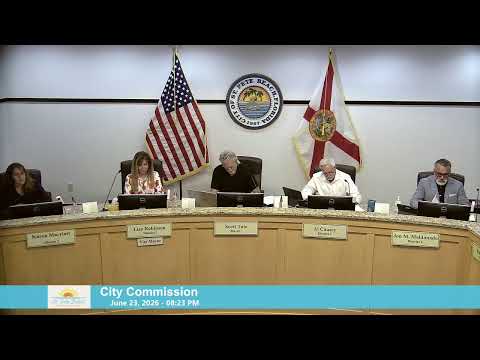
St. Pete Beach adopts 50-foot beach sign buffer, limits permanent posts after heated public comment
Summary
After hours of public comment about customary-use rights and private property signs, the St. Pete Beach commission adopted Ordinance 2026-11 banning posts and fixed signs within 50 feet of the Gulf waterline and limiting portable A-frame signs landward of that zone, adding language to preserve Florida customary-use rights.
The St. Pete Beach City Commission on June 23 adopted Ordinance 2026-11, prohibiting signs, posts and poles within 50 feet of the mean high or visible waterline and allowing only limited, permit-regulated portable sandwich-board signs landward of that zone.
City Attorney read the ordinance at second reading and stressed urgency: if not adopted, an emergency ordinance that has been protecting the 50-foot buffer will expire on June 27. The version adopted tonight preserves a 50-foot “no post” safety zone along the Gulf and requires a permit, survey and deed/title documentation for any sign placed between the 50-foot line and the dunes.
The ordinance as adopted includes staff recommendations that portable A-frame sandwich-board signs may be allowed upland of the 50-foot zone, removed at sunset, unilluminated, no more than 5 feet tall with an 8-square-foot maximum face area, and spaced a minimum distance (the commission agreed on a 300-foot separation to be limited to signs "on the same zoning lot"). The ordinance also inserts the phrase that “nothing in this sign code shall supersede, negate, or infringe upon Florida’s customary use doctrine.”
The debate was lengthy and often contentious. Dozens of residents and property owners spoke during public comment. Several residents asserted longstanding public rights to walk and use both dry and wet sand; Amanda San Yego said, “I hereby assert my right to the customary use of St. Pete Beach,” and other speakers described the beach as central to tourism and community identity. Dominic Iscaro told commissioners that private signs can be used “to intimidate beachgoers” and urged stronger limits, while hotel and resort representatives said markers and signs are necessary to protect property, reduce liability and give law enforcement clear boundaries.
Attorney Alyssa Gagnon, speaking for some property owners, argued the ordinance as drafted risked First Amendment and preemption problems: she told the commission the measure “is not a narrow safety regulation. It is an outright speech ban” and warned it was vague about mean high waterline versus visible waterline and could conflict with Florida trespass statutes that make posted notice enforceable (she cited Sections 810.09 and 810.10).
Commissioners framed the measure as a public-safety and aesthetic tool intended to keep the shoreline clear for walkers and wildlife; Commissioner Causey emphasized safety at night and the danger of fixed posts. Several commissioners expressed reluctance to ban signs outright but said doing nothing would allow the emergency ordinance to lapse and leave permanent posts in place. After negotiated edits (including limiting the 300-foot spacing to the same zoning lot, adding “rebar” to enumerations, and adding the customary-use preservation clause), the commission voted 5-0 to adopt the ordinance with modifications.
The ordinance also preserves exemptions for government signs (for example, marine turtle nest markers placed at the direction of authorized permit holders) and directs staff to finalize permit fees and administration. The commission asked staff to return with clarifying language and implementation details, including how the permit process will verify property ownership and how enforcement will be carried out.
Next steps: the ordinance becomes permanent upon publication; staff will incorporate the agreed edits and present final administrative procedures, permit fees and enforcement guidelines to the commission for implementation.