Get Full Government Meeting Transcripts, Videos, & Alerts Forever!
Get email alerts on the Budget Advisory Opinion topic
No spam. Unsubscribe anytime.
School committee cites state advisory opinion as legal basis to proceed after towns cut parts of regional budget
Summary
The Foster-Glocester Regional School Committee discussed a Commissioner of Education advisory opinion saying town electors cannot restrict the committee’s use of non-local revenue; the ruling has spurred heated public comment over whether the budget was effectively approved after voters cut items at the financial meeting.
The Foster-Glocester Regional School Committee on Monday reviewed an advisory opinion from the Rhode Island Commissioner of Education that resolved a dispute stemming from the region’s recent financial town meeting.
Attorney Greg summarized the opinion, telling the committee that the commissioner concluded electors at a financial meeting may vote to adopt or reject the annual budget as presented but do not have authority to "reallocate or restrict the use of district funds" from non-local revenue sources such as state aid or tuition. "Those electors have no authority to modify the committee's final adopted budget, reallocate or restrict the use of district funds," Greg said while explaining the commissioner's legal reasoning.
The advisory opinion also rejected town arguments that certain debt service could be counted as part of the district’s maintenance of effort. Greg said the commissioner found that debt service which was not included in previous maintenance-of-effort calculations could not be used to justify reductions to the district’s maintenance-of-effort figure.
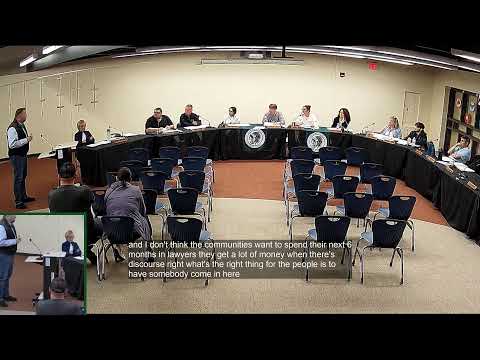
The summary prompted robust public comment. Multiple residents said the budget had been voted down at the financial meeting and argued the committee should respect that vote. "The town voted the budget down twice. So as Shelley says, you don't have a budget," one attendee said. Others urged the committee and towns to avoid costly litigation and seek collaborative solutions; one speaker recommended an independent forensic audit to rebuild trust.
Committee members said they would follow the advisory opinion as their legal guidance while also exploring improved communication with the two town councils ahead of next year’s financial meeting. Member Brandon asked the committee to consider sending a concise explanatory note to Foster and Glocester town councils summarizing the committee’s interpretation of the opinion and how it plans to proceed.
Where the committee intends to seek different procedures in future financial meetings — for example, clarifying whether voters may add or subtract to presented totals when a local appropriation request is zero — members said they will open that topic well in advance of next year's town meetings. Greg noted that the advisory opinion leaves open some procedural questions for the future, notably how voter changes would operate if the committee requests more than zero in local appropriations.
The meeting moved into public comment that included sharp exchanges over student-counting practices for home-schooled pupils and assertions that the region had "played with the numbers"; committee members said some of those technical points (for example, reporting changes from recent years) should be examined as an agenda item rather than during public comment. Greg advised the committee that the commissioner’s interpretation carries substantial legal weight in state courts.
The committee adjourned the open portion of the meeting and moved to an executive session on pending legal matters.