Get Full Government Meeting Transcripts, Videos, & Alerts Forever!
Get email alerts on the Municipal Finance topic
No spam. Unsubscribe anytime.
Olentangy officials warn growth incentives can shift school costs and say long‑term forecasts still show pressure; levy possible in 2028
Summary
Superintendent and finance staff told the board that municipal tax‑incentive tools (CRAs/TIFFs/new community authorities) can reduce school tax revenue and shift costs to other taxpayers; an updated five‑year forecast improved from February estimates but still shows cash reserves falling toward zero within several years absent policy or state funding changes.
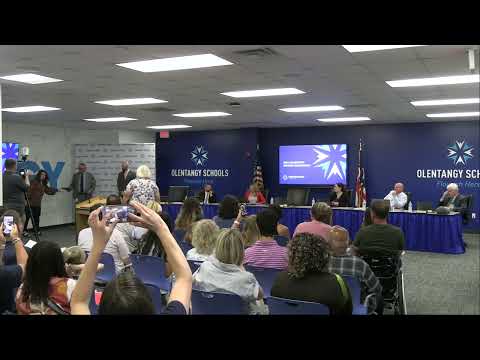
Board and finance leaders devoted a large portion of the June 24 meeting to how regional economic development tools affect school funding and to an updated five‑year financial forecast.
Superintendent Mr. Meyer and finance staff described the district’s framework for evaluating municipal incentives such as tax increment financing (TIF/CRAs) and new community authorities. They said the district prefers non‑school TIFFs or compensation where possible and noted districts have limited ability to block local tools because Ohio law allows municipalities to use certain incentive mechanisms without school board approval. Mr. Meyer summarized the position: "We're trying to be collaborative, but it's our duty to educate every child legally living in the boundaries of this district and to preserve school revenue," he said.
Treasurer staff presented a revised cash flow forecast: since February they recorded higher state aid and other revenues and lower expense trends, improving near‑term cash projections by several million dollars. However, staff said that with current assumptions the district’s cumulative cash balance would still trend toward critically low levels in the late 2020s — the presentation showed the district’s general‑fund cash reserves could reach zero in the 2028–29 school year without changes. Officials stressed variables remain: state funding formulas, cost‑set updates, and local tax actions could meaningfully shift the trajectory.
Board members and staff discussed a recent local case (Encore in Powell) where a CRA reduced the local tax duplicate and therefore school revenue. Administration said some municipalities had redrawn CRA maps and that in some instances cities have adopted non‑school TIFFs or made annual payments to districts; the district publishes active TIFF/CRA charts on its website for transparency. Mr. Meyer said commercial and industrial development is generally preferred by the district because it broadens the tax base and can reduce the burden on residents, but that residential abatements or 100% residential CRAs can create net costs without near‑term tax revenue.
On the policy horizon, officials said they are preparing for new state biennial budgeting and reiterated that House Bill 920 protections and recent state law changes affect how local mills are rolled back as property values rise. Administrators told the board they may bring an operational levy proposal to voters in calendar year 2028 if revenue and policy changes do not sufficiently alter the forecast.
Next steps: staff will continue monitoring local incentive proposals, publish updates on active TIFF/CRA items, refine the five‑year forecast as state budget details emerge and return to the board with specific levy timing and options if needed.