Get Full Government Meeting Transcripts, Videos, & Alerts Forever!
Get email alerts on the County Budget topic
No spam. Unsubscribe anytime.
Lane County adopts 2026–27 budget after tense debate over reserves and public safety funding
Summary
After hours of deliberation over reserve levels, transient lodging tax uses and road‑fund impacts, the Lane County Board of Commissioners adopted the 2026–27 budget. The board approved a one‑year allocation for rural patrol funded primarily by uncommitted general‑fund reserves and adopted the budget as amended (5–0).
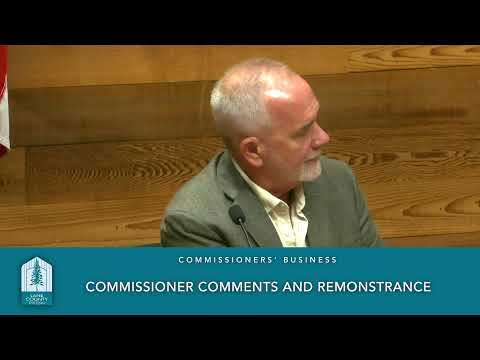
Lane County commissioners on June 23 adopted the county’s 2026–27 budget after intense discussion about how to pay for public safety without undermining long‑term reserve policy.
The board approved a compromise motion to fund a one‑year rural patrol allocation of about $1.999 million, using $2.7 million in uncommitted general‑fund reserves and a small additional draw that will briefly dip the reserve slightly below the county’s adopted 20% minimum. Commissioner Jer Farr moved the compromise; Commissioner Lowell seconded it. The motion passed 4–1, with Commissioner Trieger recorded as the sole dissent. The board then approved Order 26062313 adopting the budget as amended on a 5–0 vote.
Why it mattered: commissioners said they faced hard tradeoffs—maintaining reserves that support the county’s bond ratings and financial stability while providing immediate funding to keep rural patrols and courthouse planning on track. Several proposals earlier in the meeting—ranging from eliminating commissioners’ discretionary accounts to drawing more from road reserves or the transient lodging tax (TLT) collection—were discussed and rejected or altered.
Vice Chair Buck opened the debate with two proposals, including a motion to discontinue commissioners’ discretionary accounts and transfer roughly $60,000 to public safety. “We are in a very tight budget space,” Buck said, urging the board to examine every option. That motion was seconded by Commissioner Krieger but failed 2–3 after Commissioners Lovell, Senega and Farr voted no.
Much of the debate centered on whether to dip below the 20% general‑fund minimum the board has used to signal fiscal stability. County administrator Christine Moody cautioned that reserve policy helped secure the county’s bond rating and recommended that, if reserves were used, the board pair any drawdown with a concrete plan to rebuild reserves. “I’m not saying it will result in [a lower bond rating],” Moody said, “I’m saying it’s a consideration and something you should have a plan to replenish.”
Public Works Director Dan Hurley warned that using road reserves would accelerate staffing and project impacts. “If the 6.4 or 6.5 [million] was diverted, that would be about eight to 10 full‑time‑equivalent employees that would need to be laid off,” Hurley said, describing the practical consequences of shifting highway‑fund dollars.
Commissioner Trieger objected to what they called attempts to “backdoor” non‑budget decisions—noting that proposals to redirect transient lodging tax funds relate to broader county priorities and should be considered separately from the annual adoption of the budget. The board ultimately preserved ongoing TLT allocations and used the uncommitted general‑fund reserves as the primary bridge for the one‑year patrol funding.
The compromise approved by the board preserves the county’s ongoing TLT allocations, funds courthouse planning at the level identified by staff, and commits the board to revisit longer‑term patrol funding during the next budget cycle. The motion included direction for staff to return with a plan to restore reserves toward the 20% policy.
Following the reserve and public‑safety votes, the board unanimously adopted the overall 2026–27 budget, making appropriations and setting tax levies as described in Order 26062313.
What’s next: staff will draft the replenishment plan and return to the board during the next budget cycle. Commissioners also directed staff to continue negotiating with partners and to report back on potential long‑term solutions for rural patrol funding.
Reporting: quotes and vote tallies in this article are drawn from the June 23, 2026 Lane County Board of Commissioners public meeting transcript. The board’s final recorded votes on the reserve compromise and the budget adoption are reflected in the public meeting record.