Get Full Government Meeting Transcripts, Videos, & Alerts Forever!
Get email alerts on the Economic Development topic
No spam. Unsubscribe anytime.
Simsbury Main Street Partnership outlines 2026 priorities: office‑vacancy task force, Placer AI data purchase and downtown Wi‑Fi work
Summary
Sarah Nielsen, executive director of Simsbury Main Street Partnership, told selectmen the group will prioritize retaining existing businesses, begin a committee to address more than 25% office vacancy, pursue downtown Wi‑Fi funding and use Placer AI to analyze visitor and event data for targeted economic development.
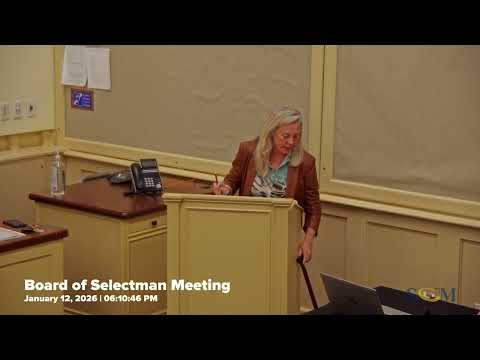
Simsbury — In an annual presentation to the Board of Selectmen on Jan. 12, Sarah Nielsen, executive director of the Simsbury Main Street Partnership, summarized the nonprofit’s 2025 accomplishments and set six goals for 2026 focused on business retention, recruitment, downtown infrastructure and events.
Nielsen said the Partnership’s top priority is keeping existing businesses open. "Transformation strategy number one, which we believe is the most important, is to retain the existing businesses," she told the board, outlining ongoing work with retailers and service providers and cooperative marketing efforts.
She reported tangible results from last year’s Shop Simsbury campaign: "We sold 432 gift cards. We raised, kept over $25,920 locally in Simsbury during two days," Nielsen said, noting the program helps participating shops and restaurants capture holiday spending locally.
Nielsen proposed a new office‑space vacancy committee after reporting that townwide office vacancy exceeds about 25 percent. The committee — planned as a public‑private effort with planning and economic development staff — would pilot adaptive reuse strategies and examine zoning and incentive tools, Nielsen said. She asked the board for selectmen representation and staff support to move projects from study to small demonstration redevelopments.
The Partnership also described two new initiatives for 2026: pursuing a downtown Wi‑Fi pack (currently unfunded) and contracting Placer AI to provide anonymized foot‑traffic and visitor‑origin analytics. "Placer AI...congregates tens of millions of cell‑phone data," Nielsen said, adding that the reports can show where visitors originate and whether they stop and spend money in town. The data, she said, can inform event planning, retail recruitment and targeted marketing.
Board members asked how Main Street will share the intelligence and who will pay for it. Nielsen said Main Street would have proprietary access and would generate reports for property owners and stakeholders; the board discussed grant funding and bundling costs to reduce per‑parcel expense.
Nielsen stressed collaboration with the Chamber of Commerce and the Economic Development Commission, saying the organizations serve different functions but should coordinate on vacancy and recruitment work. She also reminded the board that Main Street’s annual town contract now covers a substantial share of the nonprofit’s budget — "a little less than two‑thirds," she said — and that the funding helps the group provide free services to Simsbury businesses.
The presentation closed with questions about signage in West Simsbury Plaza and next steps on forming the vacancy committee. Town Manager Mark Nelson and planning staff agreed to help convene stakeholders and circulate a draft committee plan for selectmen review.
What’s next: staff will work with Main Street to finalize a scope for the office‑vacancy committee, circulate a draft for selectmen and partner comment, and return with estimated costs for any Placer AI license or downtown Wi‑Fi pilot.