Get Full Government Meeting Transcripts, Videos, & Alerts Forever!
Get email alerts on the Behavioral Health Coordination topic
No spam. Unsubscribe anytime.
Douglas County work session highlights "Familiar Faces" care-coordination gains and gaps
Summary
County staff and partners briefed commissioners on the "Familiar Faces" initiative and MyRC data-sharing work, citing measurable drops in emergency use for targeted individuals, persistent gaps in medical respite and long-term placements, and consideration of a new care-coordination platform and budget space to support it.
Douglas County officials and partner agencies used a June 24, 2026 work session to review a multi-agency effort known as the "Familiar Faces" initiative and the county's use of the MyRC data-sharing platform to coordinate care for people who repeatedly use emergency services.
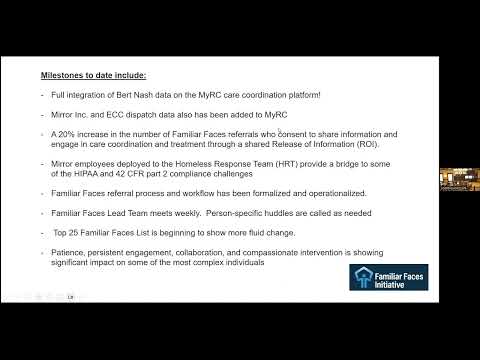
Bob Triansky, director of behavioral health projects for Douglas County, told commissioners the group's goal is to "coordinate care for 10 individuals at a time" through weekly huddles of partners who review MyRC's prioritized list. Triansky said the initiative grew from a Data-Driven Justice-style effort and that recent integrations now include behavioral-health partners such as Bert Nash and SUD provider Mirror, Inc.
Triansky highlighted concrete results from focused casework. Describing a long-term high utilizer he called "Justin," Triansky said the person's prior multi-year record included very high use of emergency care and justice-system contacts; after intensive coordination the individual's service use fell sharply. "We didn't make that happen. We created the circumstances whereby the person could find what they need and get to the point where the whole community benefits from them being in that space," Triansky said.
County staff noted MyRC now contains a 42 CFR-compliant partition for behavioral-health exchanges and that a shared release-of-information form—adapted from a tool used in Orange County—has increased signed releases by about 20 percent and produced a roughly 39 percent referral conversion rate over the past year.
At the same time, speakers stressed operational and system-level barriers remain. Triansky and partners said MyRC is largely retrospective and does not let teams close referral loops or maintain longitudinal, real-time care notes. "MyRC may not be the platform that is the best choice moving forward," a county staff member summarized after demonstrations of alternate products. County staff said they have evaluated a platform referred to in the discussion as Gelata and would need time, agreements and budget space for any conversion.
Hospital clinicians attending the session described the value of knowing who is working with a patient before the next ED visit. Kirk Sloan, chief medical officer at LMH Health, said the huddle's planning reduces repeated acute encounters: "When Bob talks about people exiting the state hospital sometimes abruptly . . . there comes a point where the benefit now is outweighed by the potential risk and it's time for them to leave the hospital. But is it more dangerous to get them out if you don't have someplace for them to go?" Sloan said.
Partners identified several concrete gaps that limit options after hospital discharge: limited medical-respite beds for short post-procedure recovery, scarce nursing-home placement capacity for patients with behavioral challenges, slow adult-protective-services and guardianship processes, and the absence of health-plan representatives at the weekly huddle because of privacy/user-access constraints. County staff said Douglas County pays a modest annual subscription to Johnson County, which built and hosts the MyRC platform, but that health-plan (MCO) representatives are typically engaged outside the weekly huddle when permitted by privacy rules.
Speakers also flagged a workforce and funding problem: shelters and some step-down programs can provide private units and coordinated supports but generally cannot assume clinical responsibility without compensation and appropriate staffing. James Chisum, executive director of Lawrence Community Shelter, described pilot "Monarch" units where the shelter provides housing and meals while clinical services are delivered by partner agencies when funding permits.
Commissioners asked staff what comes next. County staff said they are continuing demonstrations of alternative care-coordination platforms, collecting implementation questions about EHR integration and hosting responsibilities, and considering budget supplementals to hold space for a potential platform conversion. Staff also invited commissioners to identify regulatory or advocacy priorities (including payer engagement and broader Medicaid-policy questions) that could address long-term deficits in medical respite and placement capacity.
The work session recessed with staff asking partners and commissioners for feedback on next topics and any additional information they would like to guide future budget and policy work.