Get Full Government Meeting Transcripts, Videos, & Alerts Forever!
Get email alerts on the Redevelopment Pilot topic
No spam. Unsubscribe anytime.
Residents press council over Hopewell 57 pilot deal, attorney bars council discussion ahead of planning-board hearing
Summary
Residents accused borough leaders of approving a pilot-tax deal that advantages a developer and leaves schools and the county with reduced revenues; the borough attorney advised council members not to comment on the pending planning-board application citing quasi‑judicial rules.
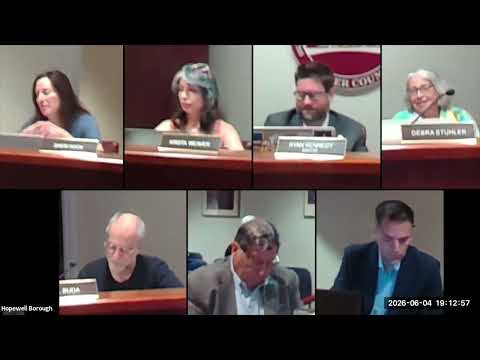
Mayor Kennedy convened the June meeting of the Hopewell Borough Council while dozens of residents used the public-comment periods to press elected officials over the Hopewell 57 redevelopment project and a related pilot‑tax agreement.
Why it matters: Speakers said the pilot deal reduces long‑term tax revenues to the borough and leaves the local school district materially worse off. At the same time, the attorney’s procedural warning that council members must avoid commenting on material related to the pending planning‑board application has limited the ability of elected officials to respond in public at this stage.
Tom Masters, a resident who presented a financial analysis to the council, said the pilot agreement will pay the borough roughly $11.6 million over 30 years while the redeveloper will save an estimated $40–42 million in taxes compared with normal property‑tax receipts. "The school gets nothing," Masters said, adding his calculation that the school district would have received much higher revenue under a standard tax regime. Masters urged council to review pilot terms more closely before approving future agreements.
Several other residents echoed concerns that council and staff relied on developer‑sponsored analyses—described in the meeting as a white paper—without adequate independent review or community engagement. Rocket Street and other speakers also reported delays in responses to Open Public Records Act (OPRA) requests related to redevelopment materials.
Town legal counsel addressed the assembly to outline a procedural limit on speaking about the pending application. The attorney said the planning board "acts by law as an independent quasi‑judicial body" and cautioned that council members cannot comment on or discuss aspects of the application, including related ordinance numbers, because doing so could prejudice the planning‑board hearing. The attorney clarified that residents remain free to speak during public comment but asked elected officials to refrain from engaging on the application during the council meeting.
Council members and staff responded to procedural and records questions: Administrator Jerry said staff would follow OPRA procedures for formal records requests and that some responsive documents had already been shared to show good faith. Mayor Kennedy asked residents to file specifics with the administrator so staff can build files and provide data to engineers and attorneys for formal review.
What the council did: The council did not take formal action on the Hopewell 57 application at the meeting. The attorney’s admonition left the substantive review to the planning board’s upcoming public hearing and internal legal review. Council members said they are receiving resident input and would continue to coordinate with the planning board and borough professionals.
Authorities and legal context: The meeting referenced the Open Public Records Act (OPRA) as the statutory mechanism governing public‑records requests; the borough attorney stated that OPRA governs handling and response to the requests made by residents.
Next steps: The planning‑board process will proceed; the borough attorney and planning‑board counsel will continue to advise on permissible communications. Residents seeking records were advised to submit OPRA requests; those who pressed for additional review said they intend to press the council and planning board for broader community engagement on redevelopment projects.
Ending: The council took no legislative action on the redevelopment at the meeting; the planning‑board process and OPRA responses remain the next procedural steps.