Get Full Government Meeting Transcripts, Videos, & Alerts Forever!
Get email alerts on the Zoning Text Amendment topic
No spam. Unsubscribe anytime.
Natrona County P&Z tables "warehousing" zoning amendment for further review of setbacks, lot size and building limits
Summary
Planning staff proposed TA26-01 to create a discrete "warehousing" use (defined as storage of personal property in an enclosed structure) with a proposed 2-acre minimum lot size; commissioners raised concerns about height, lot coverage, and potential leasing and unanimously tabled the item to April 14, 2026 for staff to return with options.
The Natrona County Planning and Zoning Commission on March 10 debated a proposed zoning text amendment (TA26-01) that would create a separate "warehousing" use, define it as the storage of personal property in an enclosed structure for use by the property owner, and set a proposed 2-acre minimum lot size. After extended questions from commissioners about setbacks, maximum building size and possible unintended uses, the panel voted unanimously to table the amendment to April 14, 2026 and directed staff to return with alternative setbacks, lot-size thresholds and options for limiting building footprint.
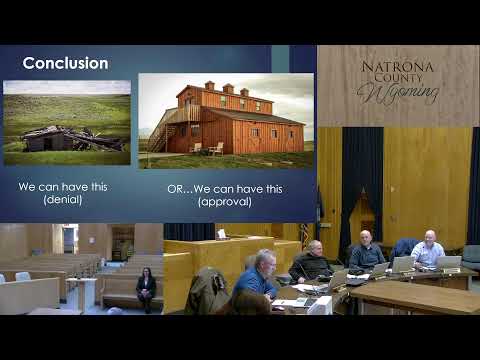
The staff presentation, delivered by Sabrina of the county planning office, explained that the amendment would remove ‘warehousing’ from a combined wholesale/distribution section and create a standalone Section 4.08.15 listing where warehousing would be allowed and the associated site requirements. "We propose to define warehousing as the storage of personal property within an enclosed structure for use by the property owner," Sabrina said, and noted the packet removed the phrase "mini storage" to avoid implying rental storage businesses in residential areas.
Commissioners pressed staff on the proposed two-acre minimum, noting the amendment had originally been proposed at five acres. Sabrina said two acres reflected conversations with commissioners, code enforcement and residents and that the county health department had told staff that two acres is typically workable for future septic layouts. Commissioners nevertheless raised a range of concerns: whether livestock barns would be included (staff said the "includes but not limited to" language was intended to permit livestock if explicitly clarified), whether large nonresidential structures would swamp neighboring homes, and how the lack of a height limit for nonresidential structures in some zones could allow very large steel buildings adjacent to residences.
Several commissioners suggested potential guardrails: reducing maximum lot coverage (one commissioner mentioned the current 50% figure for some zones), setting building-size caps as a percentage of lot area (for example, 25% instead of 50%), increasing side and rear setbacks for lots without residences, or returning the minimum to five acres in sensitive areas. Sabrina said the zoning-certification (ZC) process provides a completeness and compliance review — including setbacks, subdivision standards and county health rules — but acknowledged that some zones currently lack a numeric height limit for nonresidential structures and that any new limits would have to be written into the amendment.
Because no members of the public attended the hearing, the commission received no outside testimony. A commissioner moved to table TA26-01 to give members time to "think through" potential unintended consequences and to ask staff to prepare comparisons and specific alternatives; the motion, amended to request review of zone-specific criteria (setbacks, maximum building sizes and lot-coverage limits), passed unanimously. The commission asked staff to communicate with commissioners by email and return a revised draft for the April meeting.
Next steps: TA26-01 will return to the Natrona County Planning and Zoning Commission on April 14, 2026 with options on minimum lot size, setbacks, and maximum building-footprint/lot-coverage language; if the commission forwards a recommendation it will go to the county commissioners for final action.
"We will absolutely verbalize all of this to them — your concerns," Sabrina said when commissioners requested the concerns be highlighted for the county commissioners.