Get Full Government Meeting Transcripts, Videos, & Alerts Forever!
Get email alerts on the Nolanville Corridor topic
No spam. Unsubscribe anytime.
Nashville MTA selects HDR for Nolanville Pike corridor planning in $9.8 million contract
Summary
The board authorized a professional services contract with HDR Engineering to advance the Nolanville Pike all‑access corridor to 30% design, approving a $9.5 million contract plus a $300,000 contingency to prepare the corridor for federal funding competitions.
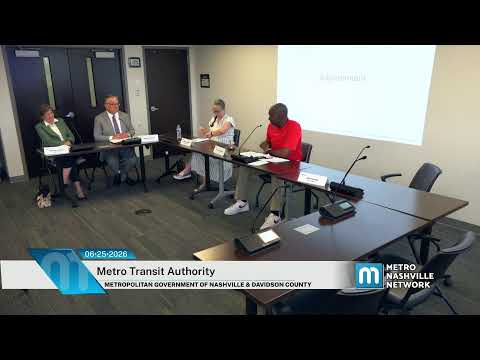
The Nashville MTA board on June 25 authorized the chief executive to execute a professional services contract with HDR Engineering to advance the Nolanville Pike all‑access corridor to 30% design and prepare it for federal competitive funding.
Denise Richardson (procurement) and Michael Briggs (deputy director, Choose How You Move program office) briefed the board on MA26‑025, describing a qualifications‑based selection process that drew six proposals. Staff said HDR’s initial cost proposal was $10.8 million; after negotiations HDR submitted a best‑and‑final offer of $9.5 million. Staff recommended a $300,000 contingency for a total project budget of $9.8 million. The contract term was described as 24 months with two possible six‑month extensions at the CEO’s discretion.
Briggs said the study will include comprehensive outreach and analysis of station locations, right‑of‑way tradeoffs, traffic access, cultural and environmental impacts, utility constraints and implementation risks. He also said advancing Nolanville to 30% design will strengthen the agency’s ability to compete for Federal Transit Administration capital grants.
Jessica Dolphin stated she would recuse herself from the vote because of a business relationship at her day job with the Trans Alliance; the recusal was recorded before the board voted. With that recusal noted, the board approved the HDR contract.
Staff told the board the project team expects the study to run roughly 24–30 months and emphasized that near‑term rider benefits—such as more frequent service, expanded link zones and signal upgrades—will continue while project development proceeds.
Next steps: HDR will begin project development work, staff will convene outreach and community advisory processes, and the agency will advance corridor work to support future federal grant applications.