Get Full Government Meeting Transcripts, Videos, & Alerts Forever!
Get email alerts on the Data Centers topic
No spam. Unsubscribe anytime.
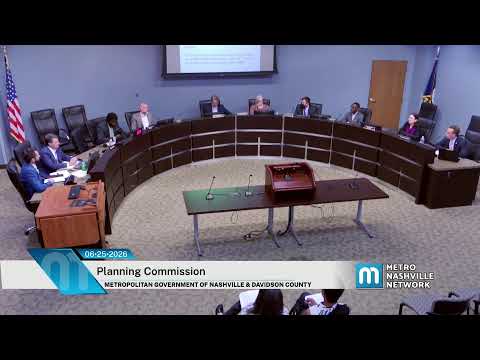
Planning commission backs substitute data-center zoning ordinance after public health and generator debate
Summary
The Metropolitan Planning Commission voted to approve a substitute zoning amendment for data centers after hours of public comments about air quality, noise and emergency generator use; staff recommended the substitute, which adds buffers, performance standards and a 72-hour backup limit with emergency exceptions.
The Metropolitan Planning Commission on Thursday voted to approve a substitute zoning amendment for data centers, sending the proposal to Metro Council after a staff briefing and a two-hour public-comment period dominated by concerns about on-site backup generators.
The commission's action adopted staff's recommendation to approve a substitute ordinance that establishes where data centers can locate, sets separation distances and performance standards, and tightens permitting requirements. Dustin Shain, a staff planner, told commissioners the substitute keeps commonly used separation distances, adds a half-mile buffer from major transit "all access corridors," requires closed-loop cooling, references ASHRAE 90.4 efficiency standards and strengthens a renewable-energy requirement to 15 percent (allowing offsite additive options). Shain said the substitute also recommends annual monitoring for onsite pollutant generation and that violations would be enforced through environmental court with Hub Nashville as the collection point for complaints.
The ordinance addresses generators and emissions but preserves an emergency exception. Councilman Horton, who moved to adopt staff's recommendation, noted the draft limits backup, emissions-causing generation to 72 hours "outside of emergencies or without the permission of NES," but allows longer operation if an emergency is declared. "My thought would be to keep it at the 72-hour limit," Horton said, asking whether facilities should be required to find non-emitting alternatives if emergencies last longer. "If that expires before the emergency ends, then they would shut down or find some other way to power themselves with renewable energy," he said.
Public commenters urged stricter limits. "Gas generators are one of the most insanely polluting tools that data centers utilize," said Drew Small during the public-comment period, and he urged the commission to "put stricter regulations on these gas generators." Several speakers also raised noise concerns and the proximity of a proposed DC Blocks facility to the zoo and nearby schools.
Representatives for the applicant contested some claims. "DC Blocks will not make more than 65 decibels worth of noise at the property line," said Doug Sloan, adding that generators are exercised infrequently "once every 2 months for 20 minutes" and for longer tests once a year. Sloan said the building is vested and that the developer seeks to work with the zoo on mitigation.
Staff and commissioners discussed technical trade-offs and the difficulty of carving out narrow exemptions. Lisa (staff) and others said some data centers serve critical users — hospitals or utilities — making a strict universal 72-hour cut-off complicated. Commissioner Dunden observed that data centers can support critical systems such as traffic signals and hospital operations and that "you don't know what information is at the traffic lights that are being run in that data center." Several commissioners said the focus should be on cleaner generator technology and enforceable monitoring rather than only hard runtime limits.
Shain also noted that the substitute aligns with state law (including public chapter 961) on grid upgrades, clarifies definitions, adds correctional facilities as sensitive uses requiring buffers and calls for further study of accessory or integrated data centers. Staff recommended approval with a substitute and noted Metro Council will hold a public hearing on the ordinance July 7.
After additional discussion, Councilman Horton moved to adopt staff's recommendation; the motion was seconded and approved by voice vote. The commission adopted the substitute ordinance and will forward the recommendation to Metro Council.
The commission's action was procedural: the Planning Commission recommended approval to the Council; final adoption will occur at Metro Council. The substitute retains a 72-hour baseline for backup generator operation absent emergencies or NES approval and strengthens a range of performance and location standards while preserving state-law limits on Metro's authority over federal and state emissions standards.