Get Full Government Meeting Transcripts, Videos, & Alerts Forever!
Get email alerts on the Bridge Replacement topic
No spam. Unsubscribe anytime.
Andover moves forward with Long Hill Road bridge replacement; commission seeks clearer DPW oversight before final approval
Summary
Town consultants outlined plans to replace aging Bridge 4582 on Long Hill Road with an 80-foot clear span to reduce scour and improve flood flows; commissioners accepted the application for the record but asked DPW to provide more detail and requested a pre-construction meeting before issuing a permit.
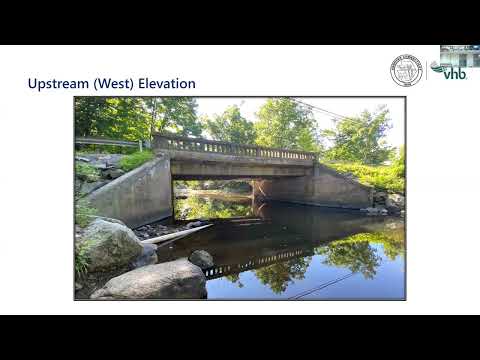
Greg Garish, the consulting engineer for the town of Andover, presented a state- and federally-funded plan to replace Bridge 4582 on Long Hill Road, describing an 80-foot clear span intended to improve hydraulics and reduce scour risk.
Garish told the commission that the structure is nearly 100 years old, was found to be scour‑critical in a 1999 analysis and currently carries about 400 vehicles per day. The replacement would double the existing channel opening (from roughly 40–43 feet to an 80‑foot clear span), add a 5.5‑foot sidewalk on the west side, install riprap and toe boulders to protect embankments, and include a "wildlife shelf" beneath the span to allow animals and inspection access. He said the project is administered by Connecticut DOT, is receiving federal funding, and had been advertised for bid.
Engineers estimate a modest hydraulic benefit: the project modeling indicates roughly a one‑foot reduction in upstream 100‑year water‑surface elevation and an improved condition compared with the current, constricted opening. The design also includes erosion controls, staged cofferdams and dewatering basins to complete work behind confinement, and requirements for contractor stormwater and sediment controls.
The presentation included quantified environmental impacts. Garish reported temporary watercourse impacts of about 713 square feet, permanent watercourse/widening impacts in the order of 1,000 square feet related to the larger opening, total wetlands impacts of approximately 1,559 square feet, and an area of special concern of roughly 16,200 square feet for roadway, sidewalk and embankment work. The design anticipates a net excavation of about 750 cubic yards from widening; staff said soils testing is underway and the excavated material is expected to be reusable but final stockpile locations will be decided by the contractor with town coordination.
On species protection, consultants said fisheries and state wildlife reviewers have signed off on permit plans that include a reptile mitigation plan and a qualified herpetologist to conduct pre‑construction sweeps and oversee protections during sensitive periods. The permit package contains a seasonal restriction for unconfined in‑stream work (June 1–Sept. 30) and requires third‑party inspection and monitoring during construction.
Commissioners raised several operational and oversight questions. Multiple members said they remain concerned about how town public‑works preparatory activities are coordinated when the town itself is the operator, citing the earlier Bunker Hill bridge work as an example where pre‑construction clearing and bank work were visible and not fully described to the commission. Members requested that the new public‑works director or staff attend the next meeting, asked that the town develop a pre‑construction meeting and draft permit conditions, and sought assurances about where excavated material would be staged so recreational areas (the ball fields) are not used as a de facto stockpile.
The commission accepted the application for the record but did not vote to issue a permit at tonight's meeting. Members asked staff to request DPW attendance at the next meeting, prepare recommended conditions for pre‑construction oversight (including limits of clearing and contractor submittals), and confirm third‑party inspection arrangements before final action.
The project schedule presented calls for a spring start and an approximate November completion, subject to permits and contractor selection. The Army Corps verification and final federal paperwork will be completed after a contractor is chosen, staff said.