Get Full Government Meeting Transcripts, Videos, & Alerts Forever!
Get email alerts on the Agro Tourism topic
No spam. Unsubscribe anytime.
Andover commission details agritourism rules: special permits, acreage thresholds, trial period and sound limits
Summary
The Planning & Zoning Commission reviewed proposed agritourism regulations that would require site plans for farm‑related events, special permits for non‑agricultural events, minimum parcel sizes (3 acres agricultural, 10 acres non‑agricultural), amplified‑sound windows and a one‑year trial period for permits.
The Andover Planning & Zoning Commission on Nov. 18 reviewed a proposed agritourism regulation intended to help farmers supplement income while limiting impacts on nearby residences.
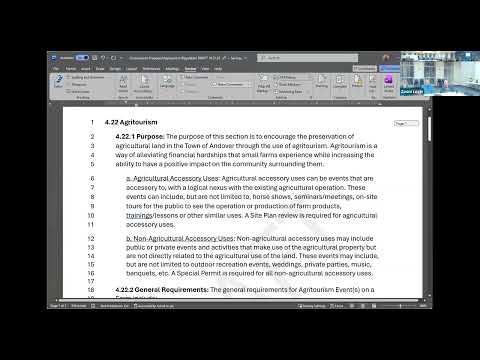
A commission member presenting the draft said the rule clarifies agricultural accessory uses (horse shows, wine lectures and other farm‑related activities) and adds a mandatory site‑plan review for such uses. Non‑agricultural accessory uses — defined to include outdoor recreation, weddings, private parties and banquets — would require a special permit and a public hearing.
The draft sets a minimum parcel size of 3 acres for agricultural accessory uses and 10 acres for non‑agricultural accessory uses. "We were looking for non‑agricultural related uses that would be at least 10 acres and for an agricultural related accessory use it would be 3 acres," the presenter explained.
The rules would also require applicants to submit a site plan showing setup and takedown procedures and to demonstrate how they will meet state sound‑attenuation limits at property lines. Proposed amplified‑sound hours in the draft were: Fridays, noon–9 p.m.; Saturdays, 10 a.m.–9 p.m.; Sundays, initially 10 a.m.–8 p.m.; and on other days, noon–8 p.m. The commission later amended the adopted package to change the Sunday start time to 11 a.m.
To allow the commission to observe effects during a busy season, special permits for agricultural and non‑agricultural accessory uses would be issued on a trial basis of up to one year; during that period a permit could be revoked after notice and a hearing. After the trial year, approvals could be made permanent but would remain subject to annual review, inspection and a $100 renewal fee.
Public commenters raised concerns about the draft’s geographic reach and its relationship to property classifications under Public Act 490. One resident noted that the assessor’s 490 list shows dozens of parcels that would meet the 3‑ and 10‑acre thresholds, and warned that the non‑agricultural category could allow commercial activity near schools, the town hall and other sensitive locations.
Commissioners said the special‑permit process is the primary tool to ensure an event is genuinely accessory to farming, noting applicants will need to demonstrate farming is their primary business. The commission also emphasized language allowing case‑by‑case modifications — for example, to limit hours for events adjacent to churches or residences.
The commission closed the public hearing and later approved the broader set of zoning changes (see related coverage), including the amended Sunday start time for amplified sound.